Southern Africa occupies a singular position within the African continent. While many African regions are primarily associated with agriculture, hydrocarbons or demographic growth, Southern Africa stands out for its industrial capacity, sophisticated financial markets, advanced transport infrastructure and exceptional concentration of strategic mineral resources.
The region combines immense economic potential with persistent structural vulnerabilities. It hosts Africa’s largest industrial economy, some of the world’s richest mining deposits, globally significant logistics corridors and several of the continent’s strongest institutions. At the same time, it faces deep social inequality, energy constraints, climate pressures and high unemployment.
In an era defined by the global energy transition, geopolitical competition over critical minerals and the restructuring of international supply chains, Southern Africa has become increasingly central to the global economy.
A region at the crossroads of Africa and the world
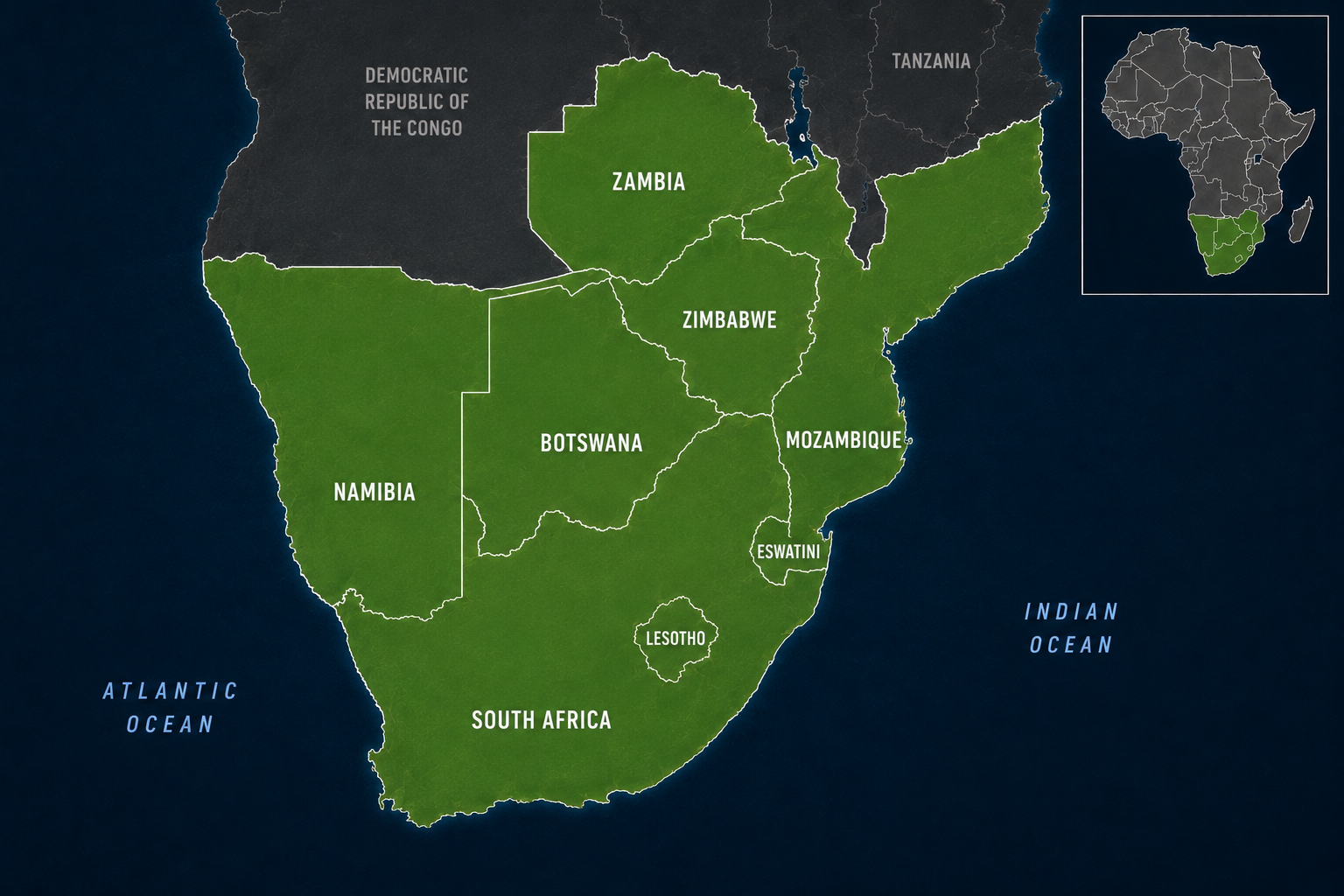
Southern Africa generally includes:
- South Africa
- Botswana
- Namibia
- Zimbabwe
- Zambia
- Mozambique
- Angola
- Malawi
- Lesotho
- Eswatini
Together, these countries cover more than 6.6 million square kilometres and are home to approximately 220 million people, making the region one of Africa’s largest economic and geographic blocs. Its strategic position connects:
- the Atlantic Ocean,
- the Indian Ocean,
- Central Africa,
- East Africa,
- and the Southern Ocean.
Major maritime routes around the Cape of Good Hope remain essential alternatives whenever disruptions affect the Suez Canal.
Africa’s industrial powerhouse
Southern Africa differs fundamentally from many other African regions because of its industrial base. South Africa remains the continent’s:
- largest manufacturing economy,
- largest financial centre,
- most diversified industrial market,
- largest stock exchange through the Johannesburg Stock Exchange (JSE),
- leading automotive producer.
Major global manufacturers—including BMW, Mercedes-Benz, Toyota, Ford, Volkswagen and Isuzu—operate production facilities in South Africa that serve both domestic and export markets. Industrial sectors include:
- automotive manufacturing,
- steel,
- chemicals,
- petrochemicals,
- machinery,
- food processing,
- financial services,
- telecommunications,
- renewable energy technologies.
This industrial ecosystem provides capabilities rarely matched elsewhere on the continent.
Exceptional mineral wealth
Southern Africa possesses one of the world’s greatest concentrations of strategic mineral resources. The region holds significant reserves of:
- platinum,
- chromium,
- manganese,
- diamonds,
- copper,
- cobalt,
- uranium,
- lithium,
- nickel,
- rare earth elements,
- gold.
South Africa alone controls roughly 70% of global platinum reserves, making it indispensable to industries ranging from automotive catalytic converters to hydrogen technologies. Botswana has become one of the world’s leading diamond producers by value, while Namibia is a major uranium exporter.
Zambia remains among the world’s major copper producers, a resource that has become increasingly important for electric vehicles, renewable energy systems and power infrastructure. These resources place Southern Africa at the centre of the global transition toward low-carbon technologies.
Critical minerals and the energy transition
Demand for critical minerals is expected to rise significantly over the coming decades. Electric vehicles require:
- more copper,
- lithium,
- nickel,
- cobalt,
- manganese.
Renewable electricity systems depend on copper, rare earth elements and platinum-group metals. Hydrogen technologies increasingly rely on platinum-based catalysts.
As governments diversify supply chains away from excessive dependence on a limited number of producers, Southern Africa has become strategically important for Europe, the United States, China, Japan and India. Competition increasingly focuses not only on access to resources but also on investment in local processing, refining and manufacturing capacity.
Regional economic integration
Southern Africa is among Africa’s most integrated economic regions. The Southern African Development Community (SADC) brings together sixteen member states with objectives that include:
- trade integration,
- infrastructure development,
- industrial cooperation,
- regional stability,
- energy connectivity.
Regional trade continues to expand through:
- transport corridors,
- customs cooperation,
- cross-border electricity markets,
- logistics partnerships.
The African Continental Free Trade Area (AfCFTA) is expected to reinforce these trends by reducing barriers to intra-African commerce.
Strategic transport corridors
Economic integration depends heavily on transport infrastructure. Southern Africa has developed several major logistics corridors, including:
- Durban Corridor
- Maputo Corridor
- Walvis Bay Corridor
- North-South Corridor
- Lobito Corridor
These networks connect inland mining regions to global markets. The Lobito Corridor, linking Zambia and the Democratic Republic of the Congo to Angola’s Atlantic coast, has recently attracted significant international investment because of its role in exporting critical minerals. Improving railways, ports and customs procedures remains essential for regional competitiveness.
Energy: opportunity and constraint
Energy remains one of the region’s defining challenges. South Africa generates most of its electricity from coal, providing energy security but also making it one of Africa’s largest greenhouse gas emitters. Recurring electricity shortages have constrained industrial production and economic growth. At the same time, Southern Africa possesses exceptional renewable energy potential:
- solar power,
- wind energy,
- hydropower,
- green hydrogen production.
Namibia has emerged as one of Africa’s most promising locations for large-scale green hydrogen projects, while South Africa continues to expand renewable energy investment.
Agriculture and food production
Despite its industrial profile, agriculture remains economically significant. Key agricultural exports include maize, citrus fruits, grapes, wine, sugar, tobacco, livestock and fisheries.
Climate variability increasingly affects agricultural productivity through drought, flooding and changing rainfall patterns. Water management has therefore become a major strategic priority across the region.
Persistent structural inequalities
Southern Africa also illustrates one of the world’s strongest contrasts between economic development and social inequality. South Africa consistently records one of the highest levels of income inequality globally. Major structural challenges include:
- high unemployment,
- youth unemployment,
- unequal access to education,
- unequal healthcare,
- housing shortages,
- regional disparities,
- informal employment.
Economic growth alone has not eliminated these long-standing disparities.
Governance and political diversity
The region encompasses a broad range of political systems and institutional capacities. Some countries have demonstrated relatively stable democratic institutions and predictable legal frameworks, while others continue to experience political tensions, governance challenges or institutional transitions. Institutional quality remains a major determinant of investment attractiveness and long-term development.
External powers and geopolitical competition
Southern Africa attracts growing international attention. Major external partners include China, the European Union, the United States, India, Japan and Gulf countries. Their engagement spans:
- mining investment,
- manufacturing,
- renewable energy,
- infrastructure,
- logistics,
- digital connectivity.
The region has therefore become an important arena of economic diplomacy, where access to strategic resources increasingly shapes international partnerships.
Future prospects
Several structural trends are likely to define Southern Africa over the coming decades:
- rising demand for critical minerals;
- industrial upgrading and local value addition;
- expansion of renewable energy;
- greater regional integration under the AfCFTA;
- modernization of transport infrastructure;
- demographic growth and urbanization;
- increasing climate adaptation efforts.
The extent to which these opportunities translate into broad-based development will depend on investment, governance, infrastructure and human capital.
Conclusion
Southern Africa represents one of Africa’s most strategically important regions. Its combination of industrial capacity, abundant critical minerals, advanced financial systems and expanding regional integration gives it a distinctive role within both the continent and the global economy.
Yet the region’s future will not be determined solely by the value of its natural resources. Long-term prosperity will depend on its ability to diversify production, strengthen institutions, improve infrastructure, expand access to opportunity and convert mineral wealth into sustainable economic development.
As the global economy increasingly revolves around secure supply chains, clean energy technologies and strategic resources, Southern Africa is positioned not simply as a supplier of raw materials, but as a region with the potential to become one of the principal industrial and economic pillars of twenty-first century Africa.
Southern Africa — 10 Key Figures
1/ ≈ 68 million inhabitants. Total population of the region, largely dominated by South Africa.
2/ ≈ $420 billion combined GDP. South Africa alone accounts for more than 80% of the region’s economic output.
3/ South Africa represents ≈ 3.5% of global GDP within the African economy. 4/ ≈ 30% unemployment in South Africa. One of the highest unemployment rates among major economies.
5/ ≈ 70% of global platinum reserves. Mainly located in South Africa.
6/ ≈ 40% of global diamond production. Driven primarily by Botswana and Namibia.
7/ ≈ 90% of South Africa’s electricity is generated from coal.
8/ Botswana ranks among the world’s leading diamond producers by value.
9/ More than 50% of regional trade relies on South African infrastructure (ports, logistics, financial services).
10/ ≈ 25% of South Africa’s population lives below the poverty line, despite being the most industrialized economy on the continent.
Strategic reading:
Southern Africa is the most industrialized region in Africa, yet it remains characterized by structural inequality, strong dependence on mineral resources, and the overwhelming economic centrality of South Africa.
Atlas Observer Research Desk
Atlas Observer’s editorial and analytical desk.