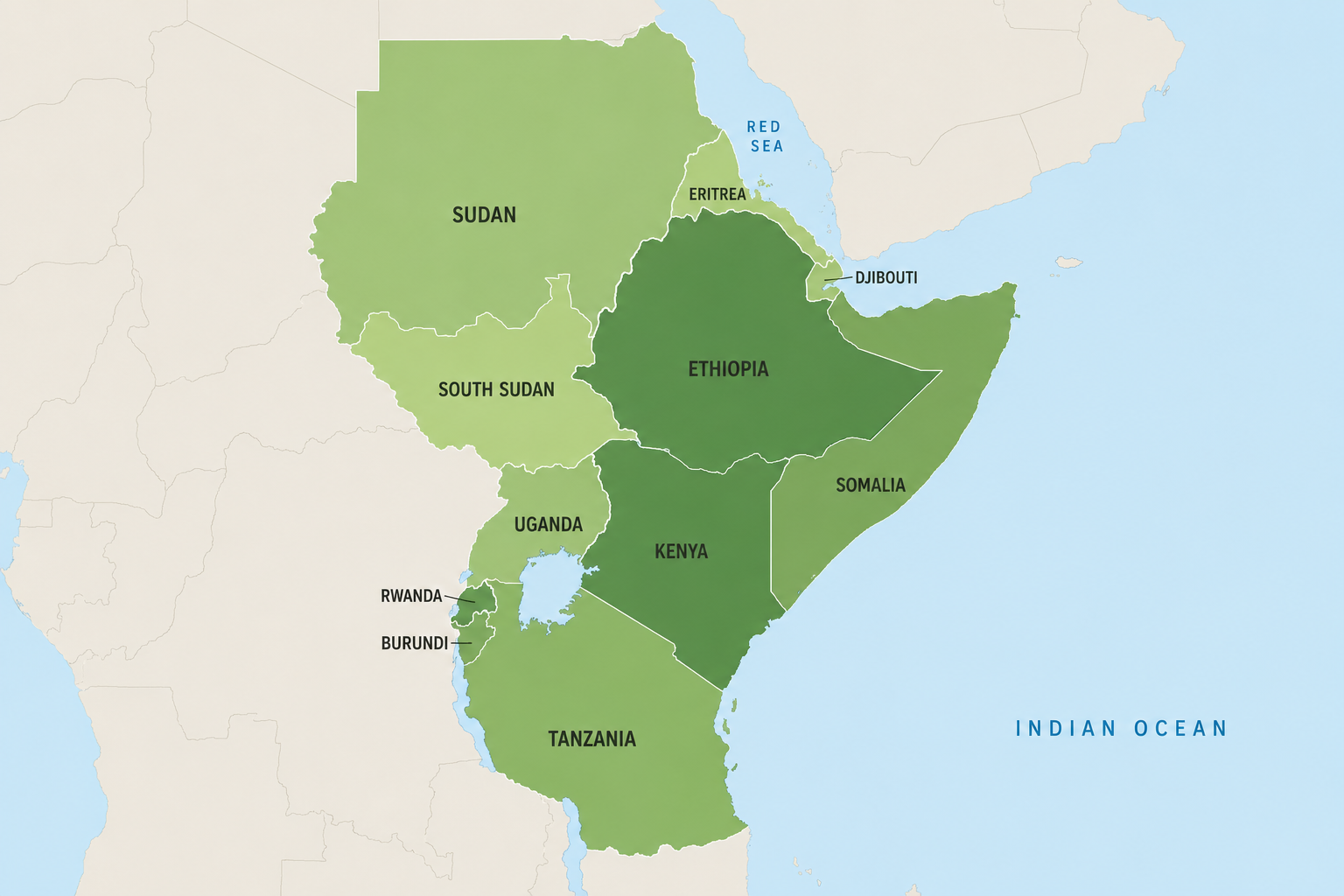
East Africa has emerged as one of the continent’s most strategically significant regions. Stretching from the Red Sea to the Indian Ocean and from the Great Lakes to the Horn of Africa, it combines rapid demographic growth, abundant natural resources, expanding infrastructure, and a strategic maritime position that places it at the crossroads of global trade.
Despite persistent challenges—including political instability in some states, climate vulnerability, security threats, and uneven economic development—the region is increasingly becoming a focal point for investment, diplomacy, and geopolitical competition.
A rapidly expanding demographic and economic space
East Africa is home to approximately 470 million people, representing nearly one-third of Africa’s population. Demographic projections suggest that this figure could exceed 700 million by 2050, making the region one of the fastest-growing population centers in the world. Its combined GDP is estimated at around US$1 trillion, although significant disparities exist between countries.The largest economies include: Kenya ; Ethiopia ; Tanzania and Uganda. Together, these countries account for the majority of the region’s economic output.
Over the past decade, several East African economies have consistently recorded annual GDP growth between 4% and 7%, supported by:
- infrastructure investment;
- expanding domestic markets;
- urbanization;
- digital innovation;
- rising regional trade.
The East African Community: one of Africa’s most ambitious integration projects
Regional integration has become one of East Africa’s defining characteristics. The East African Community (EAC) now includes: Burundi ; Democratic Republic of the Congo ; Kenya ; Rwanda ; Somalia ; South Sudan ; Tanzania and Uganda. With a market exceeding 300 million consumers, the EAC aims to establish:
- a customs union;
- a common market;
- eventually a monetary union;
- and, in the long term, a political federation.
Although implementation remains uneven, the EAC has become one of Africa’s most advanced regional integration frameworks.
Strategic maritime geography
East Africa occupies one of the world’s most important maritime corridors. Its coastline stretches roughly 7,000 km along the Indian Ocean. Major ports include: Mombasa ; Dar es Salaam ; Djibouti ; Berbera and Lamu. These ports connect:
- Africa;
- the Middle East;
- South Asia;
- Southeast Asia;
- Europe.
The nearby Bab el-Mandeb Strait links the Red Sea to the Suez Canal, through which roughly 10–12% of global maritime trade transits each year. Consequently, maritime security in East Africa has become a global strategic concern.
Energy potential transforming the region
Energy discoveries are reshaping East Africa’s long-term economic outlook. Major developments include:
- large offshore natural gas reserves in Mozambique;
- Uganda’s Lake Albert oil fields;
- Tanzania’s offshore gas resources;
- geothermal leadership in Kenya;
- expanding hydropower in Ethiopia.
Mozambique alone holds more than 100 trillion cubic feet of recoverable natural gas resources, positioning it among Africa’s leading future LNG exporters. Kenya generates nearly half of its electricity from geothermal energy, making it a global leader in renewable baseload power. Meanwhile, Ethiopia’s Grand Ethiopian Renaissance Dam (GERD) is expected to become Africa’s largest hydroelectric facility.
Agriculture remains fundamental
Agriculture continues to employ the majority of the region’s labor force. East Africa is a leading global producer of: tea; coffee; flowers; horticultural products; sesame and livestock. Ethiopia remains one of the world’s largest Arabica coffee producers. Kenya ranks among the world’s largest tea exporters and is also a major supplier of fresh flowers to European markets.
Agriculture increasingly combines traditional production with modern agribusiness, export-oriented value chains, and digital farming technologies.
Digital innovation redefining financial inclusion
East Africa has become an international reference for financial innovation. Kenya pioneered mobile money through M-Pesa, fundamentally transforming financial inclusion. Today:
- most Kenyan adults use mobile financial services;
- mobile payments account for the majority of retail digital transactions;
- fintech ecosystems are expanding across Uganda, Rwanda and Tanzania.
The region is increasingly attracting venture capital focused on:
- fintech;
- logistics;
- health technology;
- agricultural technology;
- digital public services.
- Nairobi has become one of Africa’s principal technology hubs.
Infrastructure driving regional transformation
Massive infrastructure investment has accelerated regional connectivity. Major projects include:
- Standard Gauge Railway;
- Lamu Port-South Sudan-Ethiopia Transport Corridor (LAPSSET);
- new highways;
- electricity interconnections;
- logistics corridors;
- fiber-optic networks.
These investments seek to reduce transport costs, facilitate intra-African trade, and strengthen connections between landlocked countries and international markets.
Persistent structural challenges
Despite strong progress, East Africa faces considerable structural risks. These include:
- political instability in parts of the Horn of Africa;
- armed conflicts;
- terrorism;
- food insecurity;
- climate shocks;
- high public debt in several countries;
- infrastructure financing constraints.
Recurring droughts linked to climate variability continue to affect millions of people and threaten agricultural productivity. Rapid urbanization also places increasing pressure on housing, water, sanitation, education and employment.
An arena of global geopolitical competition
East Africa has become an increasingly contested geopolitical space. China has financed major infrastructure projects through the Belt and Road Initiative. The United States continues to maintain significant security partnerships and military cooperation. The European Union remains a major development and trade partner. Turkey has expanded its diplomatic, commercial and defense presence.
The Gulf states have increased investments in ports, logistics, agriculture and food security. India, Japan and South Korea are also strengthening their economic engagement. As competition intensifies, East African governments increasingly pursue diversified partnerships rather than exclusive strategic alignments.
East Africa combines many of the structural drivers that are likely to shape Africa’s future: demographic expansion, urbanization, technological innovation, regional integration, renewable energy development and strategic maritime geography.
Its long-term trajectory will depend on its ability to translate rapid growth into inclusive development while strengthening governance, resilience and regional stability. If current integration efforts continue and infrastructure investments deliver their expected productivity gains, East Africa is likely to become one of the principal engines of African economic transformation during the coming decades.
East Africa — 10 Key Figures
1/ ≈ 470 million inhabitants ; One of the most demographically dynamic regions in Africa.
2/ ≈ $1.05 trillion combined GDP ; A rapidly expanding economic area.
3/ ≈ 5% average annual growth ; Among the fastest-growing regions on the continent.
4/ ≈ 6% of global natural gas reserves (Mozambique) ; A potential major future energy hub.
5/ ≈ 60% of global tea production (Kenya) ; Global leader in key agricultural commodities.
6/ ≈ 80% of financial transactions in Kenya via mobile money ; One of Africa’s most advanced digital economies.
7/ ≈ 25% of global Arabica coffee production (Ethiopia) ; A major player in global agricultural markets.
8/ More than 40 million people dependent on food aid ; Reflecting structural climate vulnerability and recurring food crises.
9/ ≈ 7,000 km of strategic coastline along the Indian Ocean ; A key corridor linking Asia, the Middle East and Africa.
10/ A region at the center of geopolitical competition ; Growing presence of external powers including China, the United States, Turkey and Gulf states.
Atlas Observer Research Desk
Atlas Observer’s editorial and analytical desk.