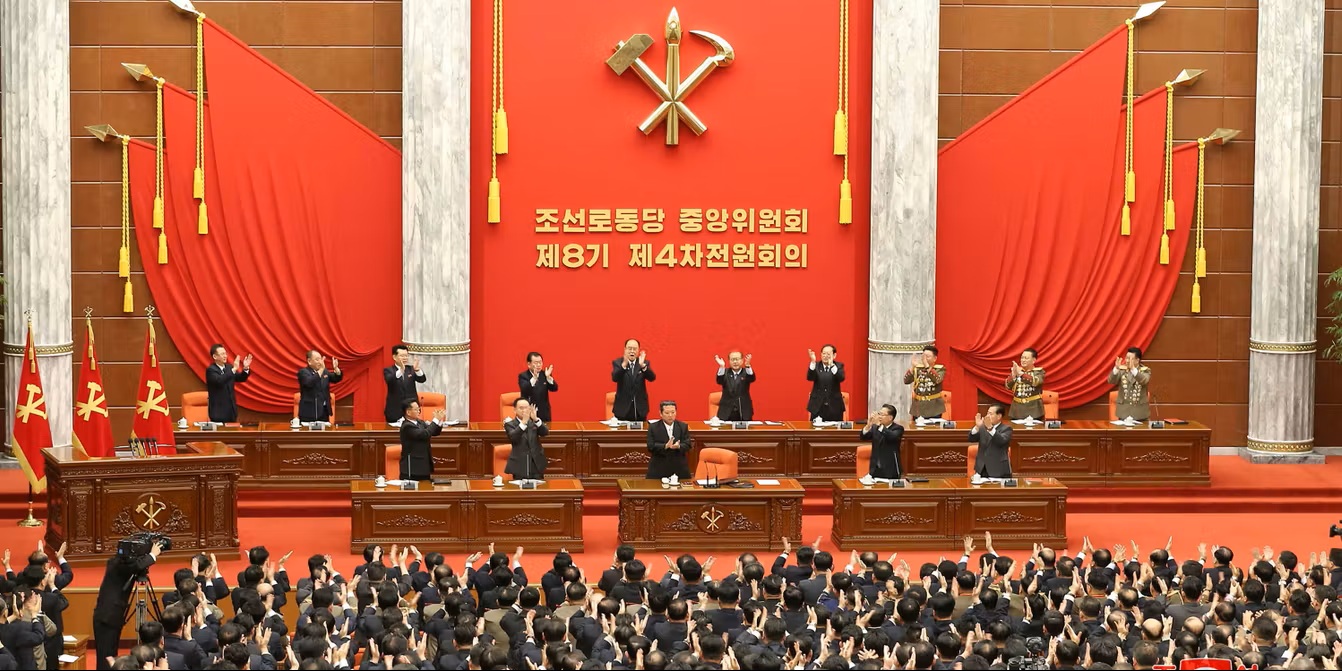
North Korea occupies a singular position within the international system. With limited economic capacity and weak integration into global trade, it nonetheless remains a strategic actor factored into the calculations of major powers. This position is rooted in a mode of exercising power that diverges from conventional standards based on economic size, trade openness, or institutional influence.
I- Deterrence as the foundation of strategic credibility
Nuclear and ballistic capabilities form the core of North Korea’s strategic posture. They provide a level of deterrence sufficient to influence the decision-making of counterparts, particularly the United States and its regional allies. This capability is not designed for classical power projection, but rather for stabilization through constraint, by raising the potential cost of external intervention.
II- An asymmetrical strategy adapted to a constrained environment
In a context dominated by actors with superior economic, technological, and military resources, North Korea relies on an asymmetrical approach. This approach is based on the optimization of limited means, combined with calibrated management of tension and negotiation cycles. It allows the country to maintain strategic relevance in regional dynamics, particularly vis-à-vis South Korea and Japan.
III- Indirect integration into geopolitical balances
Despite relative isolation, North Korea remains embedded in regional dynamics through its relationships with China and, to a lesser extent, Russia. These relationships do not constitute formal alliances in the classical sense, but they contribute to stabilizing North Korea’s position by preventing full marginalization. They also place the country within broader patterns of great power competition.
IV- An economy oriented toward continuity
North Korea’s economic model is shaped by structural constraints, particularly international sanctions and limited access to global markets. In this context, the economy plays a functional role: ensuring continuity of essential activities and supporting strategic priorities. It is not a vehicle for external expansion, but a foundation for internal resilience.
V- The development of non-conventional capabilities
Beyond traditional military dimensions, North Korea has invested in capabilities with high relative efficiency, particularly in the cyber domain. These capabilities enable access to financial resources and operations across transnational spaces, with relatively low entry costs and complex attribution, reinforcing their strategic utility.
VI- A limited but structured international presence
North Korea does not possess an influence network comparable to that of major economic powers. However, it maintains targeted bilateral relations and specific channels of cooperation, notably in parts of Africa and Asia. This presence, though discreet, helps preserve external linkages and mitigates diplomatic isolation.
VII- Strategic reading
The North Korean case highlights a form of power based on a coherent combination of limited but effective levers:
- structured deterrence capability
- an adaptive asymmetrical strategy
- indirect geopolitical positioning
- targeted non-conventional capabilities
- an economy oriented toward continuity
This configuration enables North Korea to remain a factor in international balances without relying on traditional attributes of power.
Conclusion
North Korea illustrates an important evolution in contemporary power dynamics: power is not solely determined by economic size or trade intensity, but also by the ability to shape the strategic environment. In a fragmented international system, limited but well-calibrated levers can be sufficient to ensure a durable strategic presence.
Atlas Observer Research Desk
Atlas Observer’s editorial and analytical desk.