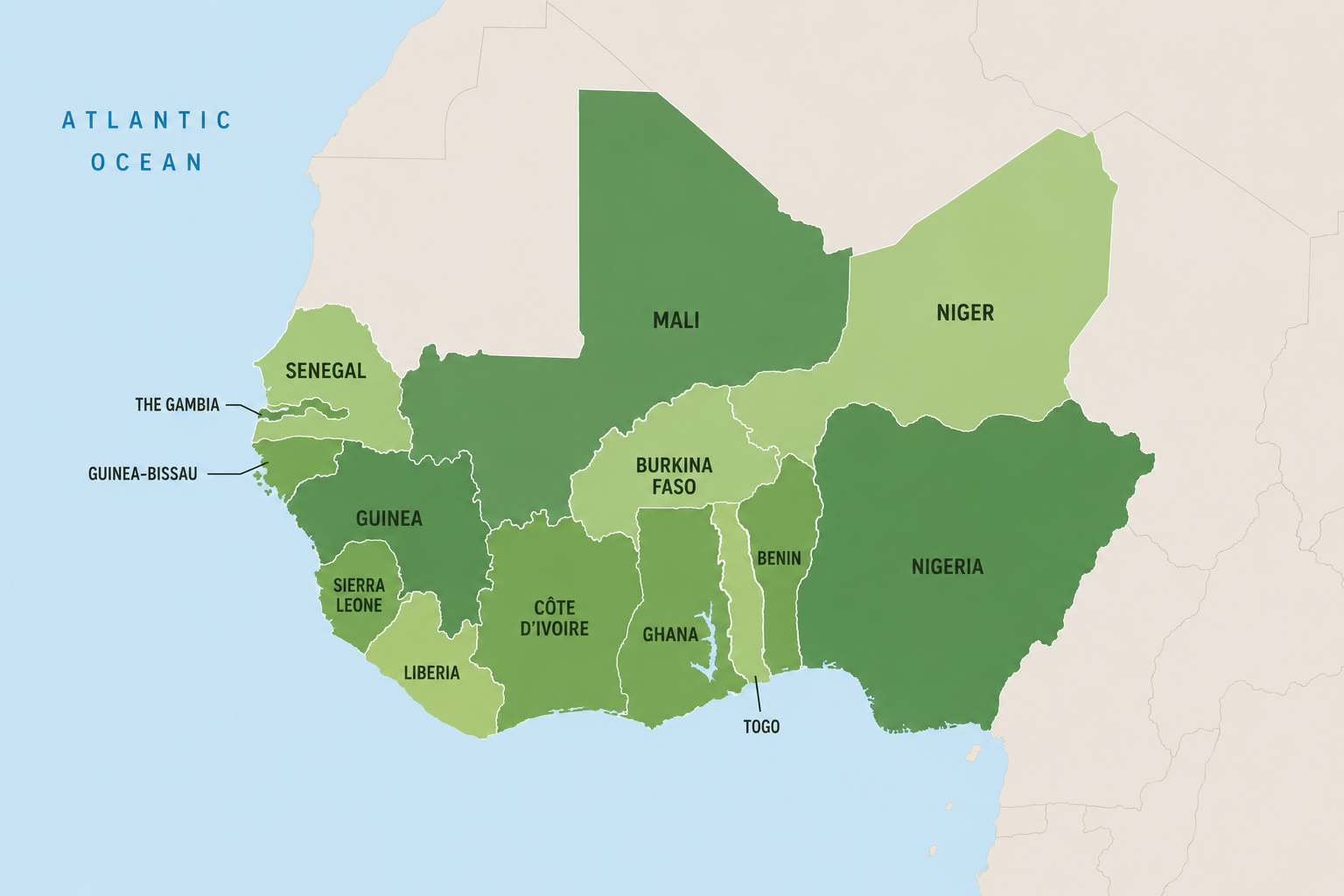
West Africa occupies a distinctive position in today’s geopolitical landscape. Located at the intersection of the Atlantic Ocean, the Sahel and the Sahara, it forms a transition zone between sub-Saharan Africa, North Africa and the major transatlantic trade routes. This geographical position gives the region strategic importance that extends far beyond the African continent.
Comprising sixteen states and nearly 430 million inhabitants, or approximately one-third of Africa’s population, West Africa is now one of the continent’s main demographic and economic centres. Its importance derives not only from the scale of its natural resources, but also from the growth of its domestic markets, the rapid expansion of its cities and its central role in Sahelian security dynamics.
West Africa is therefore a region where development, governance, security and international competition increasingly intersect.
A regional economy undergoing transformation
With a combined gross domestic product of approximately 800 billion dollars and average annual growth close to 4% in recent years, West Africa is gradually emerging as one of the continent’s leading economic regions. Nigeria overwhelmingly dominates the regional economy. With a GDP estimated at around 470 billion dollars, it has long ranked among Africa’s largest economies. Its regional weight is reinforced by the size of its domestic market, its energy sector and its expanding services industry.
Several fast-growing economies have also developed around this regional power. Côte d’Ivoire has become one of the principal engines of Francophone Africa, while Ghana continues to diversify through its mining, energy, agricultural and financial sectors. Senegal is also experiencing sustained economic expansion, supported by public investment, infrastructure development and the emergence of offshore gas production.
This growth is accompanied by rapid urbanisation. Lagos has become one of the world’s largest metropolitan areas, while Abidjan, Accra and Dakar are strengthening their roles as regional financial, logistical, commercial and diplomatic centres.
Natural resources at the centre of global interests
West Africa contains some of the world’s most strategically important natural resources. Nigeria remains one of Africa’s leading oil producers, with output generally fluctuating between 1.3 and 1.5 million barrels per day. More recently, the development of offshore gas fields between Senegal and Mauritania has opened new energy prospects for the region.
West Africa’s subsoil is also particularly rich in mineral resources. Guinea holds approximately one-quarter of the world’s bauxite reserves, a mineral essential to aluminium production. Ghana, Mali and Burkina Faso are among Africa’s major gold producers, while Liberia and Sierra Leone possess substantial iron ore deposits. Niger has historically occupied an important position in uranium production.
Agriculture remains another major pillar of regional economies. Côte d’Ivoire and Ghana together account for a large share of global cocoa production, while Nigeria has the largest agricultural sector in West Africa. Agricultural and cereal-producing areas in countries such as Mali and Senegal also play an important role in regional food security.
This abundance of resources represents a major economic advantage. However, it also intensifies geopolitical competition and raises persistent questions concerning governance, value distribution, industrialisation and dependence on commodity exports.
A highly diverse political landscape
West Africa does not follow a single political model. Institutional trajectories vary significantly from one country to another. Countries such as Ghana, Senegal, Côte d’Ivoire and Cabo Verde have developed relatively consolidated political institutions and have experienced electoral transitions, although democratic tensions and governance challenges remain.
Other states continue to face considerable institutional fragility. Nigeria is confronted with security, economic and communal tensions, while Guinea, Liberia and Sierra Leone remain engaged in longer-term processes of institutional consolidation.
In the Sahel, Mali, Burkina Faso and Niger have experienced military coups since 2020, illustrating the vulnerability of political systems operating under conditions of prolonged insecurity, declining public trust and limited state capacity. This institutional diversity has become one of the principal obstacles to deeper regional integration.
The Sahel as the main centre of instability
Security has become one of the defining issues shaping the region’s future. The Liptako-Gourma area, situated around the borders of Mali, Niger and Burkina Faso, remains a major concentration point for violence involving armed organisations affiliated with Al-Qaeda and the Islamic State.
This deteriorating environment has profoundly altered regional balances. The withdrawal or reduction of several Western military deployments, the emergence of alternative security partners and the growing political influence of military authorities reflect a broader reconfiguration of the strategic landscape.
Instability is no longer limited to the central Sahel. Coastal states along the Gulf of Guinea have strengthened their security systems to prevent the southward expansion of armed groups. Côte d’Ivoire, Ghana, Benin and Togo have increased investment in border surveillance, intelligence, military presence and regional coordination. The stabilisation of the Sahel has therefore become a central determinant of security across West Africa as a whole.
A region increasingly shaped by international competition
West Africa’s growing strategic importance is attracting an expanding range of international actors. The United States has traditionally focused on security cooperation, counterterrorism, governance support and selected development initiatives, while maintaining a relatively limited direct military presence.
The European Union combines economic partnerships, development assistance, security cooperation and migration policy. European states also remain significant commercial and diplomatic actors across the region.China has expanded its influence through infrastructure financing, construction projects, trade, public lending and investment in extractive industries. Its presence has become particularly visible in transport, energy, mining and public infrastructure.
Russia has strengthened its relationships with several Sahelian governments through security cooperation, diplomatic support and military partnerships. Its expanding role reflects both regional demand for alternative partners and the weakening of several longstanding Western relationships.
The diversification of international partnerships gives West African governments additional diplomatic room for manoeuvre. At the same time, it increases the region’s exposure to strategic rivalry between external powers.
Regional integration under increasing pressure
Since its creation in 1975, the Economic Community of West African States, or ECOWAS, has served as the region’s principal institutional framework. Its objectives are ambitious: economic integration, the free movement of people and goods, policy coordination, conflict management and the preservation of regional stability.
Recent political crises have nevertheless exposed the organisation’s limitations. Tensions between ECOWAS and the military-led governments of Mali, Burkina Faso and Niger have weakened regional cooperation and raised fundamental questions about the future architecture of West African integration. The creation and consolidation of alternative regional frameworks in the Sahel have further complicated the institutional landscape. As a result, ECOWAS now faces the challenge of preserving economic and political cooperation while adapting to a more fragmented regional order.
Its ability to maintain dialogue, uphold its governance principles and prevent durable regional division will be one of the major institutional tests of the coming years.
The structural forces shaping the region’s future
Three major trends are likely to shape West Africa over the coming decades. The first is demographic growth. The region’s population could approach or exceed 800 million by 2050, making West Africa one of the world’s principal centres of demographic expansion.
The second is urbanisation. Major metropolitan areas will continue to concentrate populations, investment, innovation and economic activity. This process will create significant opportunities, but it will also place enormous pressure on housing, transport, infrastructure, employment and public services.
The third concerns energy and industrial transformation. Global demand for aluminium, critical minerals, hydrocarbons, electricity and agricultural commodities may increase the strategic value of several West African economies. However, the scale of the opportunity will depend on whether states can move beyond the export of raw materials and develop local processing, industrial capacity, regional value chains and more sophisticated economic ecosystems.
Conclusion
West Africa stands at a pivotal moment in its development. Its demographic scale, abundant resources, expanding cities and growing markets give it the potential to become one of the most influential regions in the global economy. At the same time, security crises, institutional fragility, regional fragmentation and international competition continue to constrain this potential.
The region’s trajectory will depend largely on three factors: the long-term stabilisation of the Sahel, the consolidation of political institutions and the capacity to transform natural resources into sustainable and inclusive economic development.
Should these conditions be met, West Africa could emerge not only as a major African centre of growth, but also as an increasingly important actor in the global geopolitical and economic system.
West Africa — 10 Key Figures
1/ ≈ 430 million inhabitants; West Africa represents nearly 30% of Africa’s total population.
2/ ≈ $800 billion combined GDP; Roughly 40% of Sub-Saharan Africa’s total economic output.
3/ Nigeria: ~ $470 billion GDP; Africa’s largest economy, accounting for more than half of the region’s GDP.
4/ ≈ 1.3–1.5 million barrels of oil per day; Nigeria is the largest oil producer in Africa.
5/ ≈ 25% of global bauxite reserves; Concentrated mainly in Guinea, a critical resource for aluminum production.
6/ ≈ 60% of global cocoa production; Produced by Côte d’Ivoire and Ghana, which dominate the global market.
7/ 3 of Africa’s fastest-growing economies; Are regularly found in the region (Côte d’Ivoire, Senegal, Benin).
8/ 5 military coups since 2020 Mali (2020, 2021), Guinea (2021), Burkina Faso (2022), Niger (2023).
9/ More than 20 million inhabitants in Lagos; One of the largest megacities in the world.
10/ ≈ 800 million people projected by 2050; West Africa is expected to become one of the world’s major demographic centers.
Structural challenges :
- Sahelian security instability
- demographic pressure
- rapid urbanization
- limited economic diversification
- climate vulnerability
Atlas Observer Research Desk
Atlas Observer’s editorial and analytical desk.