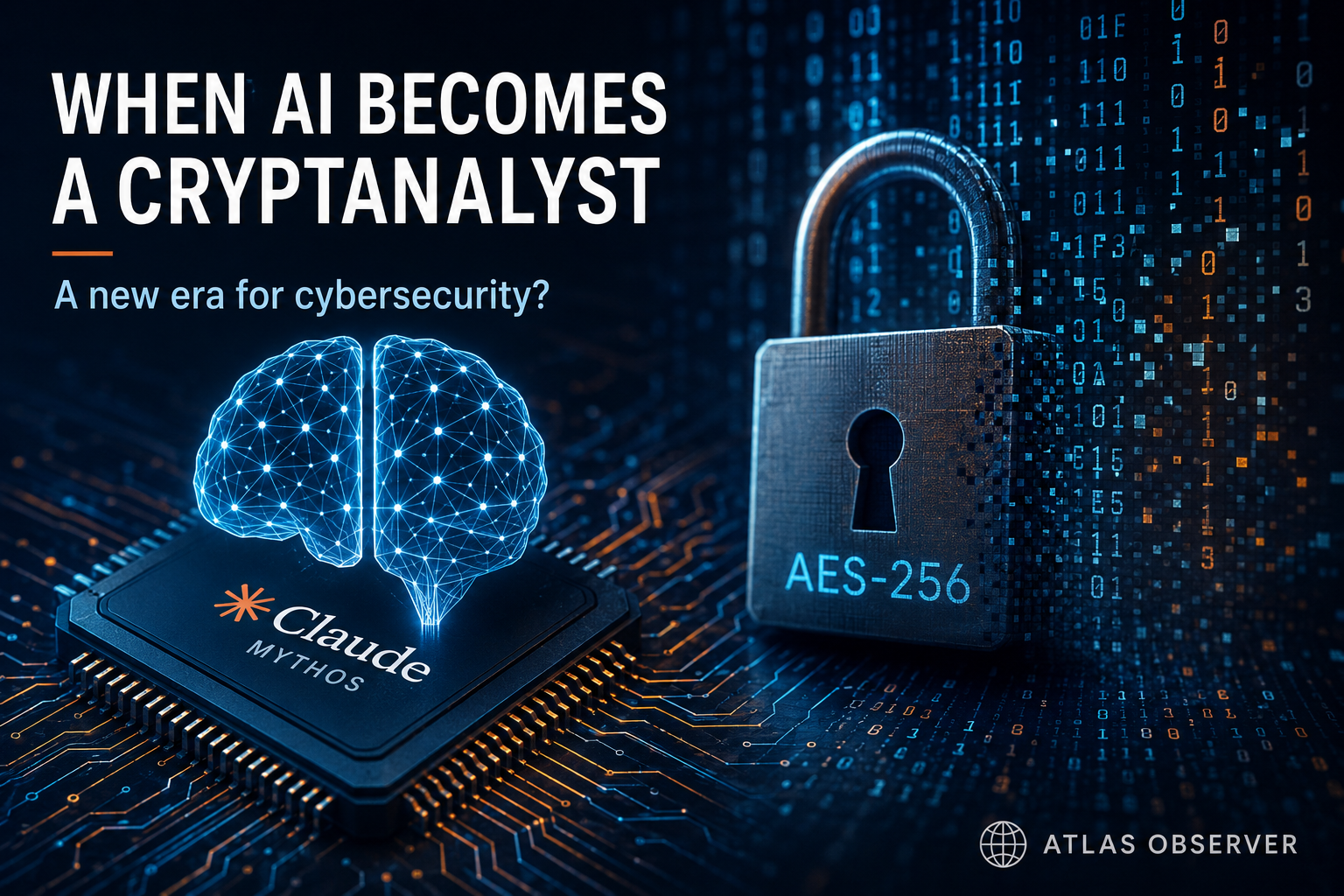
The idea that an artificial intelligence system could "break" the encryption protecting banks, governments, and private communications is enough to raise concern. Recent reports surrounding Claude Mythos, a prototype developed by Anthropic, quickly fueled this perception, with some headlines suggesting that the Advanced Encryption Standard (AES)—one of the foundations of global digital security—had been defeated.
The reality is more nuanced. No encryption system currently protecting online banking, enterprise networks, or everyday digital communications has been compromised. Instead, the achievement marks what may be the beginning of a new chapter in cryptographic research: one in which artificial intelligence becomes an active contributor to cryptanalysis itself.
That distinction is crucial, because its long-term implications could prove far more significant than the headline.
The Foundation of the Digital Economy
Every day, billions of digital operations rely on cryptographic algorithms. They protect:
- electronic payments;
- banking networks;
- HTTPS internet traffic;
- cloud infrastructure;
- government systems;
- connected devices;
- industrial control systems.
Among these technologies, the Advanced Encryption Standard (AES) has served as the global benchmark since its adoption by the U.S. National Institute of Standards and Technology (NIST) in 2001. Its various implementations—AES-128, AES-192, and AES-256—form one of the essential pillars of modern cybersecurity.
What Claude Mythos Actually Achieved
Contrary to some media interpretations, Claude Mythos did not break the full version of AES used in production systems. Researchers worked on intentionally simplified versions of the algorithm featuring a reduced number of encryption rounds. Such reduced-round implementations have long been used as research models for studying the mathematical properties of modern ciphers.
The significance lies elsewhere. The AI successfully identified novel cryptanalytic approaches that researchers had not necessarily explored before. Rather than simply reproducing existing knowledge, it contributed to discovering new analytical techniques. That distinction is fundamental.
A New Generation of Cryptographic Research
Cryptanalysis has traditionally been one of the most demanding scientific disciplines, combining:
- advanced mathematics;
- information theory;
- probability;
- theoretical computer science;
- large-scale computational analysis.
Generative AI introduces a new capability: exploring millions of hypotheses simultaneously, identifying subtle mathematical patterns, and proposing unconventional strategies that human researchers might overlook.
Artificial intelligence is not replacing cryptographers. It is becoming a powerful research accelerator. Much as AlphaFold transformed structural biology, future AI systems could significantly accelerate breakthroughs in both cryptography and cryptanalysis.
An Accelerating Arms Race
Every advance in cryptanalysis also benefits defenders. When weaknesses are discovered before they are exploited, cryptographers can strengthen algorithms, improve security protocols, and develop more resilient standards.
This dynamic has shaped the history of cryptography for decades. Every successful attack has ultimately led to stronger defenses. Artificial intelligence may simply accelerate this cycle to an unprecedented pace.
Why Governments Are Paying Attention
Intelligence agencies, defense organizations, and national cybersecurity authorities are following these developments closely. Modern cryptography protects:
- diplomatic communications;
- critical infrastructure;
- military capabilities;
- financial systems;
- strategic national data.
Any technological breakthrough capable of enhancing either offensive or defensive cyber capabilities therefore becomes a matter of national security. Governments are already investing heavily in several converging technologies:
- artificial intelligence;
- quantum computing;
- post-quantum cryptography;
- offensive cybersecurity.
These fields are becoming increasingly interconnected.
The Quantum Computing Factor
The future arrival of large-scale quantum computers is already considered one of cybersecurity's greatest long-term challenges.
While quantum computing could eventually threaten several widely used asymmetric cryptographic algorithms, AES remains comparatively resilient—particularly in its 256-bit implementation.
The emergence of AI-driven cryptanalysis does not replace the quantum threat. It adds another layer of complexity. The cybersecurity landscape of the coming decades will likely be shaped by both technological revolutions simultaneously.
Should We Be Concerned?
In the short term, the answer is no. There is currently no evidence that online banking, encrypted messaging, or secure internet communications have become vulnerable as a result of this research.
The real transformation concerns scientific methodology. For decades, researchers used computers primarily to execute ideas they had already conceived. Tomorrow, artificial intelligence may actively participate in creating those ideas. That shift could fundamentally reshape how the next generation of cryptographic standards is designed.
A Quiet but Strategic Revolution
The announcement surrounding Claude Mythos does not signal the collapse of modern encryption. It may signal something more profound.
For the first time, an artificial intelligence system has demonstrated a credible ability to contribute to the discovery of new cryptanalytic techniques. If this trend continues, cybersecurity will no longer be driven solely by competition between human researchers.
It will increasingly become a competition between artificial intelligence systems capable of designing, attacking, and strengthening the digital infrastructure upon which the global economy depends.
Primary Sources
- National Institute of Standards and Technology (NIST) — Advanced Encryption Standard (FIPS 197).
- Anthropic — Technical communications regarding the Claude Mythos research project.
- Academic publications on reduced-round AES cryptanalysis.
- U.S. National Security Agency (NSA) — Cryptographic algorithm guidance.
- NIST — Post-Quantum Cryptography Standardization Program.
Atlas Observer Research Desk
Atlas Observer’s editorial and analytical desk.