Every year, a handful of press releases issued by three private companies are enough to move billions of dollars across global financial markets. A sovereign credit downgrade can immediately increase a country's borrowing costs, influence institutional investment decisions, and, in some cases, constrain government fiscal policy.
Credit rating agencies therefore occupy a unique position within the international financial system. Although they hold no regulatory authority, they exert significant influence over the financing conditions of governments and corporations alike. Their assessments shape perceptions of credit risk and help direct the flow of global capital.
This influence raises a fundamental question: are credit rating agencies merely observers of financial risk, or have they become key actors in global economic governance?
An Industry Dominated by Three Players
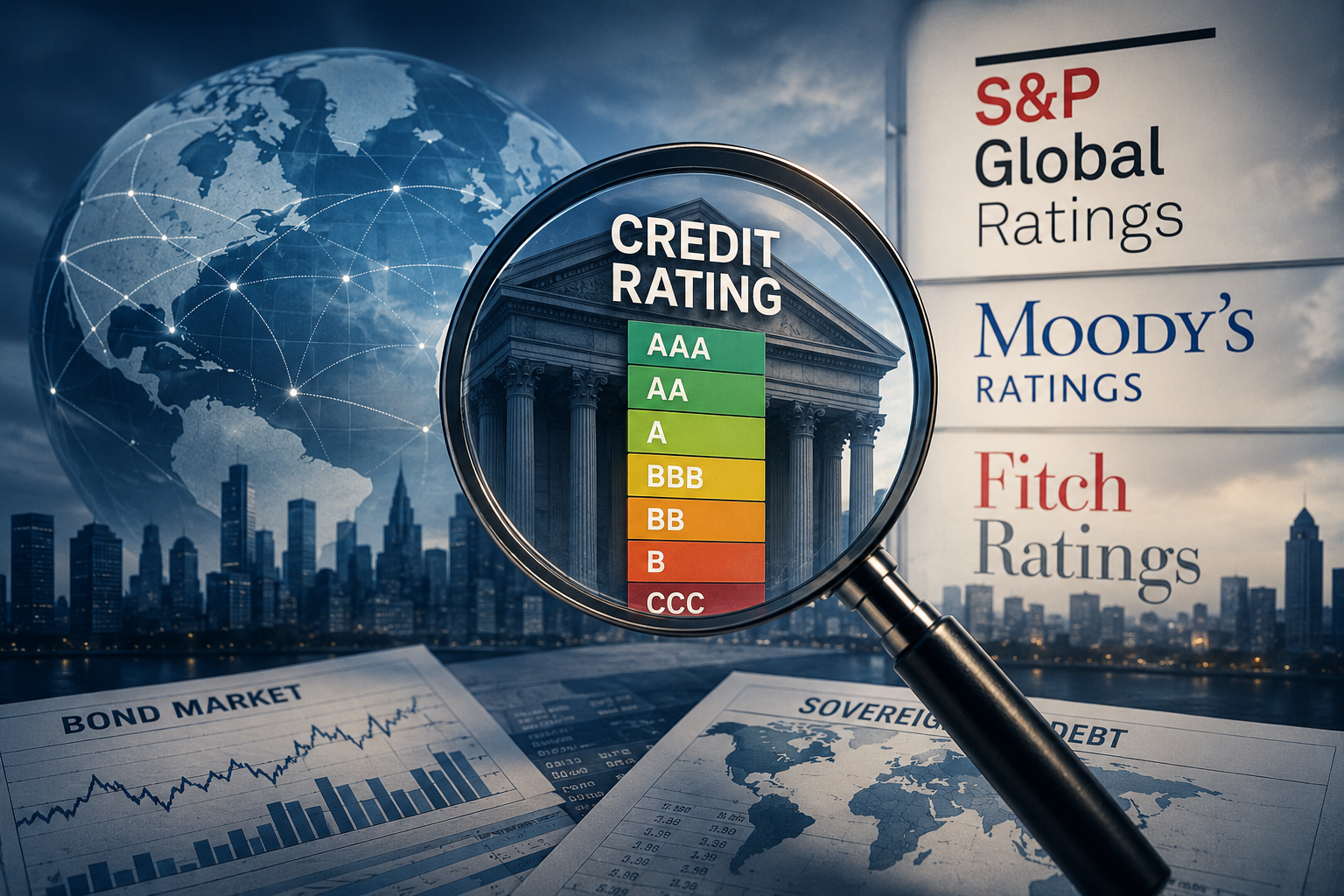
The global credit rating industry is overwhelmingly dominated by three American agencies: Standard & Poor's Global Ratings, Moody's Ratings, and Fitch Ratings. Together, they account for the vast majority of credit ratings relied upon by international investors.
Their mission is to assess an issuer's ability to meet its financial obligations. This includes sovereign governments, corporations, financial institutions, local authorities, and individual bond issuances.
The outcome is expressed through a standardized rating scale ranging from AAA, representing exceptional credit quality, to speculative-grade ratings that indicate significantly higher default risk.
While each agency applies its own analytical framework, their evaluations generally combine quantitative financial indicators with qualitative assessments of an issuer's economic, financial, institutional, and governance environment.
Credit Ratings as the Common Language of Financial Markets
In a global economy where thousands of debt securities are traded every day, investors require standardized tools to evaluate risk efficiently. Credit ratings have become that common language.
Institutional investors—including pension funds, insurance companies, central banks, and sovereign wealth funds—frequently integrate ratings into their investment mandates. Banking and insurance regulations also reference external credit assessments when determining capital requirements and risk exposures.
As a result, a credit rating is more than an opinion. It directly influences investment decisions, market liquidity, and the cost of capital throughout the global financial system.
A Direct Influence on Public Finances
For sovereign states, credit ratings play a crucial role in access to international capital markets. An upgrade generally allows governments to issue debt at lower interest rates, reducing the long-term cost of servicing public debt. Conversely, a downgrade often leads investors to demand higher yields as compensation for increased perceived risk.
This mechanism can generate a self-reinforcing dynamic. A government already facing fiscal difficulties may see its financing costs rise following a downgrade, placing additional pressure on public finances.
Credit rating agencies do not necessarily create these financial challenges, but their assessments can accelerate or amplify market reactions.
Corporations Under Continuous Assessment
Large corporations are equally affected by credit ratings. A strong credit profile facilitates access to bond markets, lowers financing costs, and strengthens confidence among investors, suppliers, and business partners.
Conversely, a downgrade may increase borrowing costs, reduce financing flexibility, or trigger automatic bond sales by institutional investors whose mandates prohibit holding lower-rated securities.
For multinational corporations, maintaining a strong credit rating has become a strategic asset alongside profitability, governance, and operational performance.
The Lessons of the 2008 Financial Crisis
The credibility of credit rating agencies came under intense scrutiny during the global financial crisis. Before the collapse of the U.S. housing market, numerous complex financial products backed by high-risk mortgage loans had received the highest possible credit ratings.
When these securities rapidly lost value, criticism intensified. The agencies were accused of underestimating underlying risks, reacting too slowly, and operating under a business model that could create conflicts of interest.
In most cases, issuers themselves pay the agencies responsible for evaluating their debt. This "issuer-pays" model has existed for decades and continues to fuel debate regarding the true independence of external credit assessments.
Although regulatory oversight and rating methodologies have been strengthened since 2008, questions surrounding accountability and incentives remain.
A More Multipolar Financial Landscape
The transformation of the global economy is gradually challenging the historical dominance of the three major Western rating agencies.
China has developed domestic credit rating institutions to support the internationalization of its financial markets, while other emerging economies are investing in their own rating capabilities.
These initiatives seek to better reflect local economic realities, reduce dependence on a Western-centered oligopoly, and accompany the rise of new financial centers across Asia, the Middle East, and other emerging regions.
Nevertheless, international investors continue to rely primarily on the established agencies, whose credibility is supported by decades of experience and widespread regulatory recognition.
Between Independence and Responsibility
Credit rating agencies occupy a paradoxical position within the international financial architecture. They possess neither legislative authority nor monetary powers. They do not enact laws or set interest rates. Yet their opinions significantly influence how governments, corporations, and financial institutions access global capital. Their authority ultimately rests on market confidence.
This reality raises an essential question: to what extent should private opinions carry such profound public consequences?
As sovereign debt, climate transition, cybersecurity, demographic change, and geopolitical fragmentation increasingly shape economic risk, rating methodologies are likely to incorporate a broader range of structural vulnerabilities.
The debate therefore extends beyond the accuracy of credit ratings themselves. It concerns the role that private institutions should play in shaping the stability of the global financial system.
Conclusion
Credit rating agencies remain one of the least visible yet most influential pillars of international finance. They do not lend money to governments or corporations, but they profoundly affect the conditions under which capital becomes available.
Their role has evolved beyond measuring creditworthiness. They contribute to the formation of market confidence, influence the allocation of global investment, and, in many cases, shape the broader dynamics of the international economy.
At a time when global public debt has reached historic levels, geopolitical fragmentation is accelerating, and new financial powers are emerging, their influence is likely to remain substantial. The central question is no longer whether credit rating agencies matter, but how their authority will evolve within an increasingly multipolar global financial order.
Main Sources
- Bank for International Settlements (BIS)
- International Monetary Fund (IMF)
- World Bank
- Organisation for Economic Co-operation and Development (OECD)
- European Securities and Markets Authority (ESMA)
- U.S. Securities and Exchange Commission (SEC)
- Standard & Poor's Global Ratings (public methodologies)
- Moody's Ratings (public methodologies)
- Fitch Ratings (public methodologies)
Atlas Observer Research Desk
Atlas Observer’s editorial and analytical desk.