When the Adversary Is No Longer a State
For centuries, warfare has been understood primarily as a confrontation between states. Military doctrines, international conventions, industrial capabilities and strategic alliances were developed around a central assumption: the adversary controlled a defined territory, possessed political institutions, commanded regular armed forces and pursued identifiable national objectives. This state-centric conception shaped international relations from the Napoleonic Wars through the two World Wars and remained the dominant framework throughout the Cold War.
Over recent decades, however, this model has been increasingly challenged by the emergence of non-state actors whose strength depends less on territorial control than on their ability to mobilize transnational networks, disseminate radical ideologies and exploit the opportunities created by globalization and digital technologies. These actors do not replace states as the principal subjects of international relations, but they introduce forms of conflict that often fall outside the traditional understanding of warfare.
This transformation does not imply the disappearance of interstate conflicts. Conventional wars remain a defining feature of the international system, as recent conflicts have demonstrated. Rather, they now coexist with forms of confrontation in which the adversary is decentralized, highly mobile and difficult to define according to classical military criteria.
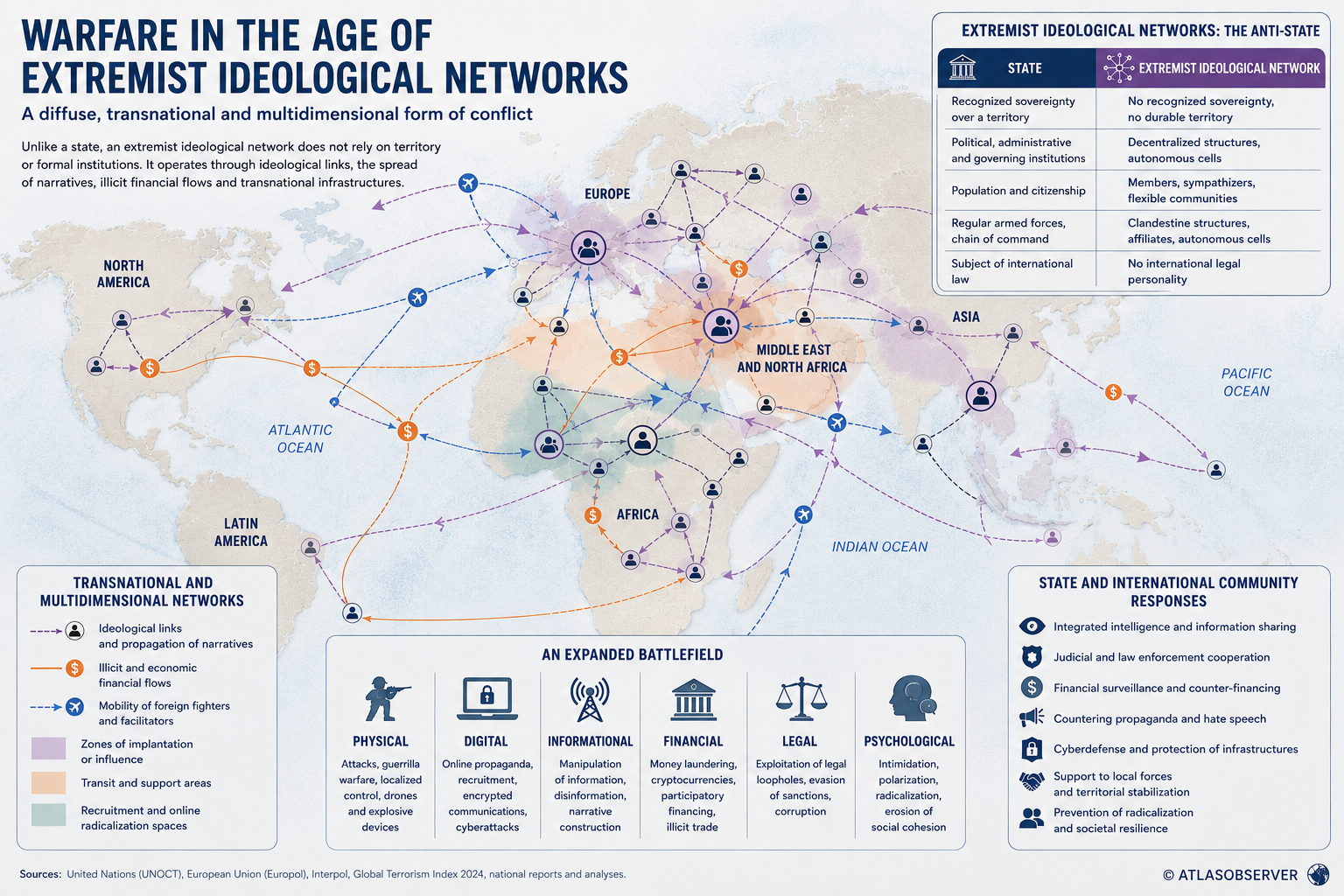
An extremist ideological network may be understood as a non-state actor composed of individuals, groups or autonomous cells connected by a radical ideology that legitimizes or encourages the use of violence to pursue political, religious or social objectives. Unlike a state, such a network generally lacks internationally recognized sovereignty, durable territorial administration and institutions exercising public authority under international law. Its resilience derives primarily from organizational decentralization, ideological cohesion, transnational support structures, digital communication and financial networks rather than permanent control over territory.
The emergence of these actors has fundamentally reshaped how governments approach warfare, intelligence and national security.
Moving Beyond Traditional Military Doctrine
Modern military doctrine has historically focused on defeating an opponent by destroying its armed forces, capturing territory and compelling political authorities to accept defeat. Victory was largely measured through military outcomes achieved on the battlefield.
Against decentralized ideological networks, however, this framework often proves insufficient. Eliminating a leadership figure, destroying operational bases or recapturing territory rarely ends the conflict. Decentralized structures frequently enable affiliated groups or autonomous cells to continue operating across multiple regions simultaneously.
Without a clearly identifiable center of gravity, the very concept of military victory becomes more difficult to define. An organization may lose much of its operational capability while preserving its ideological influence, recruitment capacity and communication networks. Conflict therefore becomes less a sequence of decisive battles than a prolonged competition in adaptation, resilience and strategic endurance.
As a consequence, military force remains necessary but increasingly functions alongside political, legal, economic and informational instruments.
Intelligence as the Primary Strategic Asset
Within this evolving security environment, intelligence has become one of the most decisive components of national defense. Military operations remain indispensable in many circumstances, but their effectiveness increasingly depends upon the quality and integration of intelligence.
Modern intelligence services combine human intelligence, signals intelligence, geospatial intelligence, financial intelligence and open-source information to reconstruct fragmented and often transnational networks. Communications metadata, financial transactions, travel patterns, publicly available information and online interactions collectively provide insights that conventional battlefield observation alone cannot deliver.
Artificial intelligence, graph analytics and large-scale data processing further enhance these capabilities by identifying hidden relationships, prioritizing threats and detecting emerging behavioral patterns across vast datasets.
This evolution illustrates one of the defining characteristics of contemporary warfare: information has become a strategic resource comparable to military manpower, industrial production or advanced weapon systems.
The Expansion of the Battlefield
Confrontation with extremist ideological networks no longer occurs exclusively on physical battlefields. It extends simultaneously into digital, informational, financial and psychological domains where traditional distinctions between domestic security and international conflict become increasingly blurred.
Digital platforms facilitate ideological dissemination, recruitment, operational coordination and global communication at relatively low cost. Encrypted messaging services, social media and decentralized online communities allow geographically dispersed actors to remain connected while reducing organizational vulnerability.
Financial systems have likewise become an essential dimension of modern security. International banking networks, informal transfer systems, cryptocurrencies and illicit financial activities may all contribute to sustaining clandestine organizations. Consequently, responses increasingly involve financial intelligence units, judicial authorities, cybersecurity agencies and international regulatory cooperation alongside conventional military institutions.
The modern battlefield is therefore multidimensional. Military power remains indispensable, but it now operates within a much broader strategic ecosystem encompassing technology, finance, law, information and public communication.
Democratic Societies Under Pressure
The evolution of extremist ideological networks presents democratic societies with a particularly complex challenge. Governments must strengthen national security while preserving the civil liberties and institutional safeguards that constitute the foundations of democratic legitimacy.
Expanded surveillance capabilities, advanced data analytics, international intelligence cooperation and the growing use of artificial intelligence all generate important debates concerning privacy, accountability, judicial oversight and the protection of fundamental rights.
Beyond legal considerations, the challenge is also societal. Preventing radicalization, strengthening social resilience, improving media literacy and countering disinformation have become essential components of national security strategies. Military action alone cannot address the underlying dynamics that enable extremist narratives to spread across increasingly interconnected societies.
Security policy has therefore evolved into a multidimensional effort combining defense, education, public policy, law enforcement and international cooperation.
A Lasting Transformation of Warfare
The rise of extremist ideological networks does not signal the end of interstate warfare. Strategic competition among major powers, territorial disputes and conventional military deterrence remain central features of the international system. However, these traditional forms of conflict now coexist with adversaries organized according to fundamentally different principles.
Contemporary armed forces must therefore prepare simultaneously for high-intensity interstate warfare and for prolonged confrontations against decentralized non-state actors whose principal advantages lie in flexibility, ideological cohesion and organizational resilience rather than conventional military strength.
This dual strategic environment requires continuous adaptation of military doctrine, intelligence capabilities, technological innovation and international cooperation. More fundamentally, it reflects a lasting transformation in the nature of conflict itself. In an increasingly interconnected world, strategic success depends not only on superior military capabilities but also on the ability to understand, anticipate and respond to adversaries whose influence extends far beyond the physical battlefield.
Atlas Observer Research Desk
Atlas Observer’s editorial and analytical desk.