Central Africa occupies a unique position in the international system. Often perceived through the lens of political instability or humanitarian crises, the region is, above all, one of the world’s most strategically significant territories. Its vast mineral wealth, immense tropical forests, major river systems, and rapidly growing population place it at the center of several of the twenty-first century’s defining challenges: the energy transition, climate change, industrial supply chains, food security, and geopolitical competition.
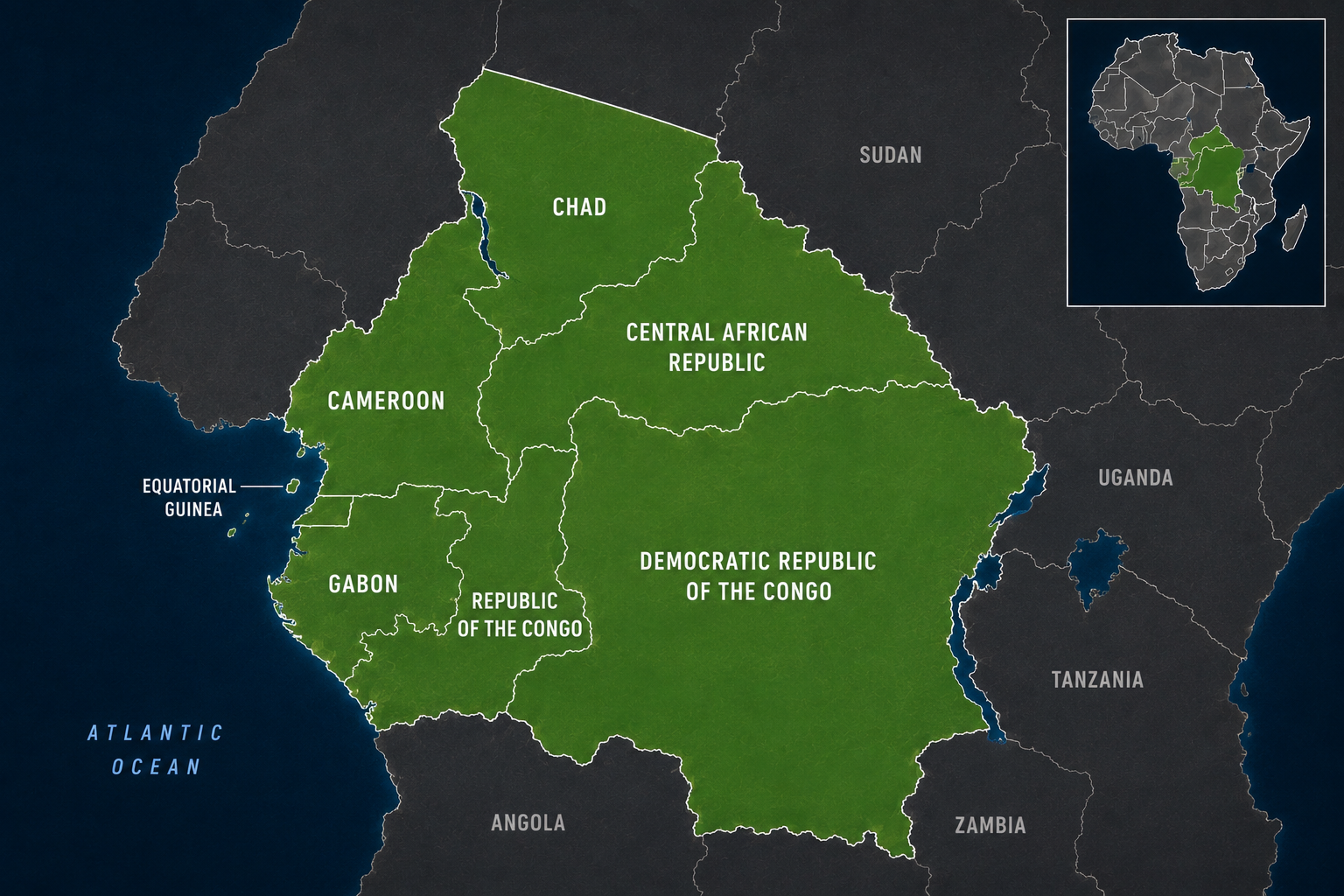
Stretching from the Atlantic coast to the Great Lakes region, Central Africa generally includes Cameroon, the Central African Republic, Chad, the Democratic Republic of the Congo (DRC), the Republic of the Congo, Equatorial Guinea, Gabon, and São Tomé and Príncipe. Together, these countries represent more than 210 million inhabitants and encompass one of the largest concentrations of natural resources on Earth.
Rather than being a peripheral region, Central Africa has become an increasingly important geopolitical crossroads where global powers, multinational corporations, regional organizations, and local governments seek to secure strategic interests.
A Region Defined by Scale
Central Africa covers more than six million square kilometers and contains extraordinary geographical diversity. The Congo Basin dominates much of the region, forming the second-largest tropical rainforest in the world after the Amazon. The Congo River, one of the planet’s largest waterways by discharge, provides immense hydroelectric potential while supporting transport, agriculture, fisheries, and biodiversity.
Population growth remains among the fastest worldwide. The Democratic Republic of the Congo alone exceeds 110 million inhabitants, making it one of Africa’s demographic giants. Combined with high fertility rates across neighboring countries, the region is expected to play an increasingly significant role in Africa’s future labor force and consumer markets.
Economic performance varies considerably. Cameroon possesses the region’s most diversified economy, while Gabon and Equatorial Guinea rely heavily on hydrocarbons. Chad combines oil production with agriculture, whereas the Democratic Republic of the Congo derives much of its strategic importance from mining.
The World’s Mineral Powerhouse
Few regions possess such a concentration of critical minerals. The Democratic Republic of the Congo produces roughly 70 percent of global cobalt output, making it indispensable to electric vehicle batteries, renewable energy storage, aerospace technologies, and advanced manufacturing. Beyond cobalt, Central Africa contains significant reserves of:
- Copper
- Coltan
- Tantalum
- Tin
- Gold
- Diamonds
- Manganese
- Uranium
- Rare industrial minerals
Many of these resources are considered critical by major economies seeking to reduce dependence on limited suppliers and strengthen strategic industrial resilience. As electrification accelerates worldwide, demand for these minerals continues to rise, increasing Central Africa’s importance within global supply chains.
The Congo Basin: A Global Climate Asset
The Congo Basin extends across approximately 220 million hectares of tropical rainforest, storing billions of tonnes of carbon while regulating regional and global climate systems. Its forests support:
- exceptional biodiversity;
- thousands of endemic species;
- major freshwater ecosystems;
- rainfall patterns affecting much of Africa;
- millions of livelihoods dependent on forest resources.
The basin represents one of the world’s largest natural carbon sinks, making its preservation an international environmental priority. Balancing conservation with economic development remains one of the region’s most complex policy challenges.
Energy Resources Beyond Mining
While minerals dominate international attention, Central Africa also possesses significant energy assets. Oil production remains concentrated in:
- Gabon;
- Republic of the Congo;
- Equatorial Guinea;
- Chad.
Natural gas reserves provide additional export opportunities, particularly through liquefied natural gas projects. Hydroelectric potential is even more remarkable.
The Congo River alone could theoretically generate nearly half of Africa’s total hydroelectric capacity. The proposed Grand Inga complex in the Democratic Republic of the Congo is frequently cited as one of the largest potential renewable energy projects ever envisioned.
If successfully developed, such infrastructure could reshape electricity access across much of the African continent.
Agriculture and Food Potential
Despite its natural wealth, agriculture remains underdeveloped relative to available resources. Large expanses of fertile land remain uncultivated or only partially exploited. Major agricultural products include:
- cassava;
- maize;
- cocoa;
- coffee;
- palm oil;
- bananas;
- livestock;
- fisheries.
Improved infrastructure, irrigation, logistics, and regional integration could significantly increase agricultural productivity while enhancing food security. Climate variability, however, continues to create uncertainty for rural populations.
Infrastructure Constraints
One of the principal barriers to economic transformation is infrastructure. Many transport corridors remain incomplete, raising logistics costs and limiting regional trade. Challenges include:
- insufficient paved roads;
- limited railway networks;
- underdeveloped ports;
- constrained electricity generation;
- weak digital connectivity in rural areas.
These structural limitations increase production costs while reducing competitiveness despite abundant natural resources. Infrastructure investment therefore remains central to the region’s long-term development strategy.
Security and Political Dynamics
Central Africa presents diverse political landscapes. Several countries have maintained relatively stable institutional environments, while others continue to experience armed conflicts, governance challenges, or political transitions. Security concerns include:
- armed groups operating in eastern DRC;
- instability around border regions;
- illicit mining;
- trafficking networks;
- humanitarian displacement.
These issues directly affect investment climates and the management of natural resources. At the same time, regional organizations continue to strengthen diplomatic cooperation on security, trade, and infrastructure.
Increasing Global Competition
Central Africa has become an arena for strategic competition among major international actors. China has invested extensively in mining, transport infrastructure, and energy projects. European countries increasingly emphasize sustainable supply chains, environmental cooperation, and responsible sourcing of critical minerals.
The United States has renewed engagement through initiatives focused on strategic minerals, energy security, governance, and investment partnerships. Meanwhile, Gulf countries, Turkey, India, and other emerging economies continue expanding commercial and diplomatic relationships throughout the region.
Rather than replacing one another, these partnerships often coexist, reflecting the region’s growing geopolitical relevance.
Opportunities and Structural Challenges
Central Africa possesses many of the ingredients necessary for long-term economic transformation:
- abundant natural resources;
- strategic minerals;
- vast renewable energy potential;
- fertile agricultural land;
- one of the world’s largest tropical forests;
- a rapidly expanding population.
However, several structural constraints continue to slow development:
- governance capacity;
- infrastructure deficits;
- limited industrial diversification;
- dependence on commodity exports;
- security challenges in specific areas;
- unequal distribution of resource revenues.
Addressing these issues will largely determine whether the region can convert natural wealth into sustained economic development.
Conclusion
Central Africa stands at the intersection of several defining global trends. The transition toward low-carbon technologies, increasing demand for critical minerals, global climate objectives, demographic expansion, and evolving geopolitical competition all reinforce the region’s strategic importance.
Its future influence will depend not only on the resources beneath its soil but also on the institutions that govern them, the infrastructure that connects them to markets, and the policies capable of transforming resource abundance into broad-based economic development.
Far from being merely a resource-rich frontier, Central Africa is emerging as one of the key strategic regions shaping the economic and geopolitical landscape of the twenty-first century.
Central Africa — 10 Key Figures
1/ ~210 million people. Population largely dominated by the DRC (~110M), accounting for more than half of the region.
2/ ~$490 billion combined GDP. Economic activity is concentrated mainly in the DRC, Cameroon, and Gabon.
3/ DRC: ~70% of global cobalt production. A critical metal essential for batteries and the energy transition.
4/ ~40% of global coltan reserves. A strategic mineral used in electronics, smartphones, and semiconductors.
5/ ~10% of Africa’s oil reserves. Production largely concentrated in Gabon, the Republic of the Congo, and Equatorial Guinea.
6/ Congo Basin: ~220 million hectares of rainforest. The second-largest carbon sink on Earth after the Amazon.
7/ ~60% of the population under 25. A strong demographic potential but significant pressure on employment and infrastructure.
8/ ~45% of Africa’s hydropower potential. Mainly located in the DRC (Congo River, Grand Inga project).
9/ ~35% of the territory rich in major mineral resources. Including cobalt, copper, manganese, uranium, gold, and diamonds.
10/ ~40% of the population living below the poverty line. Despite vast natural resources, the region remains affected by political instability and limited infrastructure.
Atlas Observer Research Desk
Atlas Observer’s editorial and analytical desk.