For much of the twentieth century, geography appeared to have lost much of its explanatory power. The expansion of international trade, the telecommunications revolution, commercial aviation, the Internet, and the financialization of the global economy fostered the belief that distance was gradually becoming irrelevant. Capital moved across borders in milliseconds, goods crossed oceans at ever-lower costs, and production chains stretched across multiple continents. Globalization seemed to herald a world in which physical borders would matter less and less.
This interpretation, appealing in its simplicity, ultimately proved incomplete. The successive crises of the early twenty-first century have demonstrated that globalization does not eliminate geography; it merely changes the way it shapes international affairs. The COVID-19 pandemic exposed the fragility of global supply chains. Trade tensions between the United States and China revealed that industrial dependencies could become strategic instruments of influence. The war in Ukraine brought energy security, food supplies, and logistical networks back to the center of international politics. Even the digital economy depends on tangible infrastructure—data centers, submarine cables, power grids, semiconductor fabrication plants, and transport networks—whose locations remain deeply rooted in geography.
Against this backdrop, one conclusion has become increasingly evident: the twenty-first century is not simply the century of Asia, as it is so often described. It is the century of Eurasia's return.
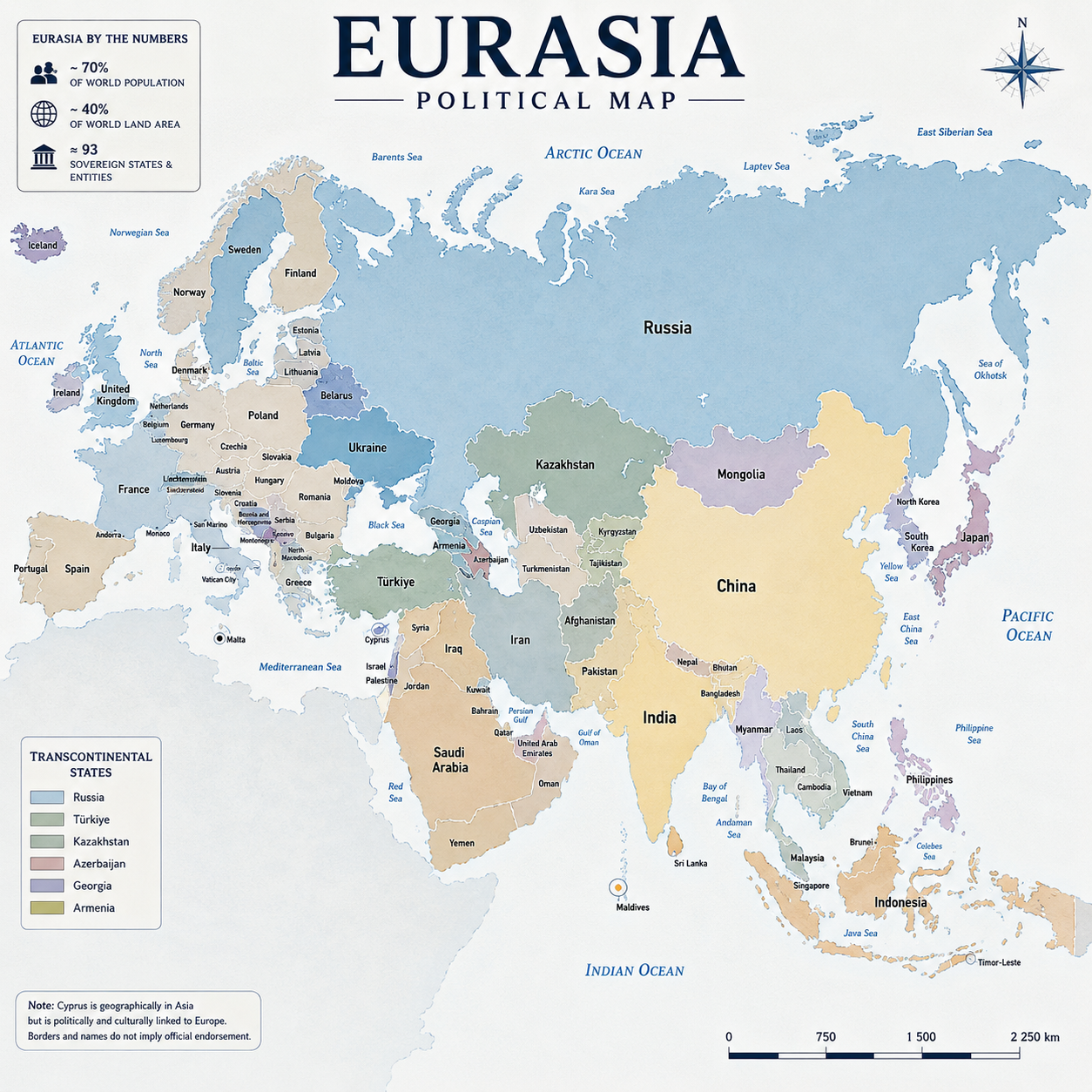
This distinction is fundamental. Referring to the "Asian century" highlights the remarkable rise of China, India, and Southeast Asia. Speaking instead of Eurasia offers a broader perspective, one in which Europe, Russia, the Caucasus, Central Asia, the Middle East, and East Asia are understood as components of a single strategic space. It is no longer the success of one region that explains the transformation of the international system, but rather the extraordinary concentration—within one continuous landmass—of the world's principal sources of power: population, industry, energy, critical resources, technological innovation, infrastructure, and military capabilities.
Eurasia is therefore far more than a geographical concept. It has once again become the framework within which the international balance of power is being redefined.
An Ancient Concept for a New World
Although the term "Eurasia" may sound modern, the reality it describes is anything but new. Long before geographers spoke of a supercontinent, the civilizations that emerged across its vast territory were already connected through continuous exchanges. From the plains of Eastern Europe to the valleys of China, from the Mediterranean basin to the steppes of Central Asia, an extensive network of land routes facilitated the movement of people, goods, ideas, and technologies.
Much of human history unfolded across this continent. Mesopotamia witnessed the birth of the first great cities and writing systems. The Persian, Greek, and Roman empires profoundly shaped political institutions and military organization. India produced some of humanity's most influential philosophical and religious traditions. China developed a sophisticated imperial bureaucracy centuries before many European states. During the Middle Ages, the Islamic world became a major center of scientific exchange, preserving and expanding knowledge inherited from Greek, Persian, and Indian civilizations.
The succession of these centers of power does not represent uninterrupted domination by a single civilization. Rather, it illustrates Eurasia's exceptional ability to generate major civilizations while encouraging interaction among them.
The history of Eurasia is therefore not one of political unity, but of permanent interdependence.
The First Globalization
When globalization is discussed, attention often turns to the Age of Discovery and the maritime revolutions of the fifteenth and sixteenth centuries. Yet centuries earlier, an earlier form of globalization was already taking shape.
The Silk Road was never a single road. It was an intricate network of routes linking China, Central Asia, Persia, the Levant, and Europe. Caravans transported silk, spices, precious stones, and metals, but their true significance extended far beyond commerce. They facilitated the circulation of ideas as much as they carried goods.
Paper, gunpowder, the compass, agricultural techniques, mathematical knowledge, banking practices, medical discoveries, and philosophical traditions all spread progressively through this vast network. Religions followed the same routes: Buddhism expanded across East Asia, Islam reached Central Asia and the Indian subcontinent, while Christianity extended far beyond the boundaries of the Roman Empire.
Eurasia had already become a space of interconnected exchanges in which prosperity depended upon the smooth circulation of people, goods, and knowledge. States that controlled major crossings, oases, mountain passes, trading cities, or maritime gateways enjoyed considerable economic and strategic advantages.
A first lesson emerges from this history: power has never depended solely on possessing territory. It has equally depended on organizing the flows that pass through it. This principle, formulated by history long before modern geopolitics, remains remarkably relevant today.
The Maritime Interlude
From the late fifteenth century onward, the strategic balance changed profoundly. Portuguese navigators opened a maritime route to India around Africa. Christopher Columbus reached the Americas. Spain, followed by Britain, France, and the Netherlands, built vast colonial empires based upon naval supremacy. For nearly five centuries, the center of global power gradually shifted toward the Atlantic world.
The Atlantic Ocean became the principal artery of international commerce. Lisbon, Amsterdam, London, and later New York emerged as the world's leading commercial capitals. Naval fleets replaced caravans. Oceanic empires overshadowed continental ones.
This transformation deeply influenced strategic thinking. Control of the seas came to be viewed as the foundation of international power. The theories developed by the American naval strategist Alfred Thayer Mahan at the end of the nineteenth century would profoundly shape the doctrines of many major powers.
Yet maritime dominance never erased Eurasia. It merely obscured its centrality. The continent continued to contain the world's major populations, its agricultural lands, its rivers, its mineral wealth, its energy resources, and its political centers. The oceans connected the world. The continent continued to produce it.
The Paradox of Globalization
Contemporary globalization is often presented as the culmination of this maritime order. Container ships, mega-ports, and global shipping lanes appear to confirm the supremacy of the seas. Yet globalization has produced an unexpected paradox.
By integrating Asian economies into the global trading system, it has progressively concentrated the world's principal centers of production within a single continental space.
- China has become the world's leading manufacturing power.
- India is emerging as one of the fastest-growing major economies.
- Japan remains a technological leader.
- South Korea occupies a strategic position in semiconductors, batteries, and advanced manufacturing.
- The European Union continues to represent one of the world's largest consumer markets while exercising considerable regulatory influence.
Between these major economic poles lie Russia, the Caucasus, Turkey, Central Asia, and the Middle East, regions that hold a substantial share of the energy, mineral, and agricultural resources upon which the global economy depends.
In other words, globalization has created an integrated economic system whose principal nodes are increasingly concentrated across a single continental landmass. This return of geography is one of the defining transformations of the twenty-first century.
The Continent of Interdependence
Eurasia's strength does not derive from the existence of a common political authority. Unlike the European Union, it possesses neither unified institutions, nor a single market, nor a shared foreign policy.
Its coherence is of a different nature. It is built upon interdependence. European industries rely on components manufactured in Asia. Asian economies import European technologies, machinery, and investment. Global markets remain highly sensitive to energy exports from Russia, the Caucasus, and the Middle East.
Critical minerals extracted in Central Asia or refined in China sustain industrial transitions across multiple continents. Rail corridors, pipelines, submarine cables, maritime chokepoints, and major ports form an increasingly interconnected network in which every link influences the others. This interdependence does not eliminate rivalry. It makes rivalry more complex.
The powers of Eurasia cooperate in certain sectors while competing fiercely in others. They may simultaneously be trading partners, industrial competitors, technological rivals, and strategic adversaries. This combination of cooperation and competition distinguishes Eurasia from every other geographical space.
The Return of the World Continent
Eurasia is not returning to the center of history because it is destined to become an empire or a federation. Its extraordinary cultural, linguistic, religious, and political diversity makes such an outcome highly unlikely.
It is returning because it concentrates the principal dynamics of contemporary power. The world's energy transition is unfolding across its territories. Global supply chains converge upon its industrial centers. Major transport corridors are being designed across its landscape. Technological competition is increasingly concentrated within its economies. Military balances are tested along its frontiers. Trade disputes frequently originate—or find their consequences—within its markets.
The twenty-first century does not therefore mark the birth of a new Eurasia. It marks the return of a historical reality that had long been overshadowed by centuries of maritime dominance. The world's largest continent has once again become the principal arena where resources, infrastructure, markets, technology, and geopolitical ambitions converge.
This resurgence does not imply that Eurasia will govern the world with a single voice. It signifies something both subtler and arguably more consequential: no major power will be able to shape the international order without understanding, influencing, or securing its position within this immense continental space.
Geography, long believed to have been relegated by globalization, has reclaimed its original role. And with it, Eurasia has once again emerged as the world's defining continent—not because it dominates every other region, but because it has become, once more, the place where the principal forces shaping the international system intersect.
Why Geography Has Become Decisive Again
For several decades, a powerful assumption dominated economic thinking and much of international scholarship: globalization would gradually diminish the importance of geography. The rapid expansion of trade, the digital revolution, increasingly integrated financial markets, and the fragmentation of global production seemed to point toward a world in which distance, borders, and physical constraints would matter less with each passing year.
This belief was not without foundation. Communications became instantaneous. Financial markets operated around the clock. A company could design a product in California, finance it in London, manufacture its components in China, assemble them in Vietnam, and sell the finished product simultaneously on every continent. Shipping costs continued to fall while digital technologies created the impression that the global economy had become increasingly detached from physical space.
Geography appeared to be losing its strategic relevance. The twenty-first century has demonstrated the opposite. The global economy has never ceased to depend on physical realities. Digital information travels through submarine cables. Data are stored in energy-intensive data centers. Electric vehicles require minerals extracted from the ground. Semiconductors are manufactured in highly specialized fabrication plants. Goods still move through ports, railways, pipelines, highways, and maritime chokepoints. The image of an economy liberated from geography proved to be an illusion. Each successive crisis has reinforced this conclusion.
The End of the Borderless World
The COVID-19 pandemic marked a decisive turning point. Within a matter of weeks, lockdowns disrupted production across large parts of the world. Supply chains fractured. Shortages spread from medical equipment to electronic components. Governments discovered that products considered essential often depended on a handful of suppliers located thousands of kilometers away. Entire industries slowed because one missing component prevented the completion of complex manufacturing processes.
The pandemic did not create these vulnerabilities. It revealed them. A few years later, the war in Ukraine produced a comparable geopolitical shock. Energy security immediately returned to the center of international politics. Grain exports from the Black Sea once again became matters of global concern. Economic sanctions demonstrated that financial systems, technological exports, transportation infrastructure, and logistical networks could all be transformed into strategic instruments.
At the same time, growing competition between the United States and China shifted international rivalry toward semiconductors, critical minerals, batteries, advanced manufacturing, artificial intelligence, and strategic technologies. These crises pointed toward the same conclusion. Globalization had not eliminated geography. It had multiplied the number of strategic dependencies rooted in geography.
Supply Chains Have a Geography
For many years, global production networks were designed almost exclusively around efficiency. Companies searched for the lowest production costs, the largest consumer markets, and the most competitive fiscal environments. This logic fragmented manufacturing across dozens of countries.
Today, a single industrial product may involve raw materials extracted on one continent, refined on another, assembled somewhere else, and finally sold across the globe. This remarkable efficiency carries an equally remarkable vulnerability. Every stage becomes a potential point of disruption.
- A natural disaster.
- A diplomatic crisis.
- A military conflict.
- A pandemic.
- A cyberattack.
- A blocked shipping route.
- A regulatory decision.
- A shortage of electricity.
Any one of these events can interrupt production chains that extend across continents. As a result, governments increasingly evaluate supply chains not only according to cost but also according to resilience. Efficiency alone is no longer sufficient. Security has become equally important.
Chokepoints: A Few Kilometers That Shape the Global Economy
Few examples illustrate the strategic importance of geography better than maritime chokepoints.A significant share of global trade passes through a remarkably small number of narrow passages.
- The Strait of Hormuz remains indispensable for energy exports from the Gulf.
- Bab el-Mandeb connects the Red Sea to the Indian Ocean.
- The Suez Canal links Europe with Asia through one of the world's busiest maritime corridors.
- The Bosporus and the Dardanelles connect the Black Sea to the Mediterranean.
- The Strait of Malacca remains the principal gateway between the Indian and Pacific Oceans.
- The Taiwan Strait has become one of the world's most strategically sensitive maritime spaces.
Some of these passages measure only a few dozen kilometers across. Yet any prolonged disruption could affect thousands of companies and millions of consumers around the globe. Most of these strategic chokepoints are located within or immediately adjacent to Eurasia. Their security therefore carries implications far beyond their immediate regions.
The Return of Continental Corridors
For centuries, maritime transport progressively overshadowed traditional overland trade routes. That trend is now partially reversing. Rail connections between China and Europe continue to expand. Infrastructure crossing Kazakhstan, the Caucasus, and Türkiye is gaining strategic importance. New corridors linking India to the Middle East and Europe are attracting substantial investment. The gradual opening of Arctic shipping routes may create additional alternatives in the decades ahead.
This evolution does not signal the decline of maritime trade. Rather, it reflects a broader effort to diversify transportation networks. States increasingly seek to avoid excessive dependence on any single route. Geography is therefore becoming as much a question of resilience as of efficiency.
Infrastructure as an Instrument of Power
Infrastructure is never politically neutral.
- Building a railway.
- Financing a port.
- Installing a pipeline.
- Deploying a submarine cable.
- Constructing an electricity interconnection.
- Establishing a major data center.
Each of these decisions reshapes economic geography. Infrastructure directs investment. It redirects trade. It creates technological dependencies. It strengthens some territories while reducing the strategic relevance of others.
Infrastructure has therefore become a geopolitical instrument. In many cases, controlling flows has become more valuable than controlling borders. This explains why large-scale infrastructure projects now occupy a central place in national strategic planning.
Energy Is Changing
For more than a century, energy geopolitics revolved primarily around oil. Natural gas later became an equally important strategic commodity. The twenty-first century has significantly expanded this equation.
- Batteries require lithium.
- Electric grids require enormous quantities of copper.
- Electric motors depend upon rare earth elements.
- Nuclear energy relies on uranium.
- Wind turbines require permanent magnets manufactured from critical minerals.
- Artificial intelligence depends upon electricity-intensive computing infrastructure.
The transition toward cleaner energy does not reduce the importance of natural resources. It changes their composition. A significant proportion of these critical resources is concentrated across Eurasia. Consequently, the continent's strategic importance continues to grow rather than diminish.
The Geography of the Digital Economy
The digital economy is often portrayed as existing in a virtual world detached from physical geography. Reality tells a different story. Nearly all international digital communications travel through submarine fiber-optic cables.
- Cloud computing depends upon vast data centers.
- Artificial intelligence requires powerful computing facilities.
- Mobile networks rely upon terrestrial infrastructure.
- Satellites complement these systems but cannot replace them.
Even the most sophisticated AI models ultimately depend upon electricity, advanced processors, water cooling systems, and stable physical infrastructure. Digital sovereignty has therefore become inseparable from industrial geography. The digital economy remains profoundly material.
Critical Minerals and the New Industrial Geography
Competition among major powers is no longer centered exclusively on hydrocarbons. Critical minerals have become strategic assets in their own right : Lithium, Nickel, Cobalt, Copper, Graphite, Rare earth elements and Uranium.
These materials constitute the foundation of electric mobility, renewable energy, advanced electronics, aerospace, telecommunications, and artificial intelligence.
Extraction is only the beginning. Refining often represents the most strategically significant stage. Manufacturing transforms these materials into high-value industrial products. This succession of industrial stages explains why governments increasingly seek to secure complete value chains rather than isolated resources. Industrial geography has become just as important as geological geography.
Economic Sovereignty
For decades, globalization encouraged the belief that economic interdependence would gradually reduce geopolitical conflict.
That assumption has not disappeared. It has been supplemented by another. Excessive dependence can become a strategic vulnerability. Governments now speak of industrial sovereignty.
- Economic security.
- Strategic autonomy.
- Supply chain diversification.
- Reshoring.
- Friend-shoring.
- Risk reduction.
Although these concepts differ, they reflect the same transformation. States are not abandoning globalization. They are attempting to regain greater control over the dependencies it creates. In doing so, they are restoring geography to the center of economic decision-making.
Eurasia at the Center of the New Geography
No other region concentrates so many strategic infrastructures.
- The principal railway corridors.
- Major pipelines.
- Gas transmission networks.
- Critical maritime chokepoints.
- Industrial clusters.
- Consumer markets.
- Critical mineral deposits.
- Refining capacity.
- Technological ecosystems.
- Military powers.
All of these dimensions converge across Eurasia. This concentration explains why so many contemporary crises possess a distinctly Eurasian dimension. Energy security. Semiconductor production. Critical minerals. Maritime routes. Digital infrastructure. Supply chains. Investment flows. Economic sanctions. Technological competition.
Each ultimately returns to the same geographical space. Geography has therefore not become important again because globalization has weakened. It has become decisive because globalization itself increasingly depends upon physical infrastructures whose principal points of convergence lie across Eurasia. The twenty-first century does not represent the end of globalization. It marks its geographical reanchoring.
Power no longer depends solely on the ability to produce wealth. It increasingly depends upon the ability to secure, organize, protect, and shape the networks through which that wealth circulates. Within this emerging architecture, Eurasia has become the world's central strategic hub—the continent where global supply chains, technological innovation, energy systems, critical resources, and geopolitical competition intersect. Understanding the new geography of power therefore means understanding why Eurasia has once again become the indispensable center of the international system.
The Eurasian Chessboard
Understanding Eurasia does not mean examining the foreign policies of dozens of individual states in isolation. Such an approach would produce little more than a collection of national case studies, each valuable on its own but incapable of explaining the larger strategic picture. Eurasia's geopolitical significance lies precisely in the fact that it functions as an interconnected system. Decisions taken in Beijing influence calculations in Brussels. Moscow's energy policy shapes industrial strategies in Berlin. India's investments in transport corridors affect the economic ambitions of the Gulf states. Developments in the Taiwan Strait reshape technological policies in Washington, Tokyo, Seoul, and across Europe.
Eurasia is not a single geopolitical actor. It is the arena where the ambitions of the world's major powers intersect, compete, and occasionally converge. Each state pursues its own interests, yet none can achieve its strategic objectives without considering the actions of the others. This web of strategic interdependence transforms Eurasia into a dynamic chessboard where balances of power are constantly evolving but rarely settled.
The Return of Classical Geopolitics
Contemporary geopolitical debates often give the impression that today's strategic competition emerged alongside globalization or the rise of China. In reality, many of the underlying dynamics were identified more than a century ago.
At the beginning of the twentieth century, the British geographer Halford Mackinder introduced one of the most influential concepts in geopolitical thought: the Heartland. He argued that the rise of rail transportation reduced the historical advantage enjoyed by maritime empires. Whoever controlled the vast continental core of Eurasia would possess immense strategic depth, abundant natural resources, and the ability to project power toward both Europe and Asia.
A generation later, Nicholas Spykman challenged Mackinder's conclusions. In his view, the decisive space was not the continental interior but the coastal margins surrounding Eurasia—the Rimland. These regions concentrated the largest populations, industrial centers, ports, and commercial routes. Controlling the Rimland would prevent any continental power from dominating the entire supercontinent.
Around the same period, the American naval strategist Alfred Thayer Mahan emphasized the decisive importance of sea power. For Mahan, command of maritime routes remained the foundation of global influence, a principle that profoundly shaped American strategic doctrine throughout the twentieth century.
Following the Cold War, Zbigniew Brzezinski revived these classical ideas in a new geopolitical context. In The Grand Chessboard, he described Eurasia as the central arena of world politics. For the United States, the strategic objective was not direct domination of the continent but preventing the emergence of any single power—or coalition of powers—capable of establishing uncontested supremacy across Eurasia.
Although these thinkers differed in their conclusions, they shared one essential insight. Eurasia remains the decisive strategic space of international politics.
China: Organizing the Continent
China's rise represents perhaps the most significant geopolitical transformation of the early twenty-first century. Within a few decades, the country has become the world's leading manufacturing economy, one of the largest sources of global investment, and a major center of technological innovation. Yet China's strategy cannot be understood through economic growth alone.
Beijing seeks to secure supply chains, diversify trade routes, reduce external vulnerabilities, and strengthen its long-term strategic autonomy. A substantial share of Chinese trade still passes through the Strait of Malacca, a maritime chokepoint long regarded by Chinese strategists as a potential strategic weakness.
Developing alternative overland connections toward Central Asia, Europe, and the Middle East therefore serves multiple purposes. These corridors increase resilience while simultaneously expanding China's economic and diplomatic influence across Eurasia.
The Belt and Road Initiative embodies this vision. More than an infrastructure program, it represents an effort to reorganize Eurasian connectivity through transportation networks, logistics hubs, energy infrastructure, digital systems, and financial cooperation in which China occupies a central position.
The objective is not necessarily to replace maritime trade. It is to multiply strategic options. In doing so, China seeks to reduce vulnerability while increasing its influence over the networks that sustain the global economy.
Russia: Preserving Strategic Depth
Russia occupies a unique position on the Eurasian continent. Stretching from the Baltic Sea to the Pacific Ocean, it controls one of the largest continuous territories on Earth. This immense geography provides extraordinary natural resources while simultaneously creating logistical, demographic, and security challenges.
Russian strategic thinking has long been shaped by one enduring principle: the search for strategic depth. Historical experiences—from Napoleon's invasion to Operation Barbarossa—have reinforced the belief that geographical space constitutes an essential component of national security. Buffer zones, secure transportation routes, and influence over neighboring regions continue to play a central role in Russian strategic culture.
At the same time, Russia remains one of the world's leading exporters of energy, agricultural products, and critical raw materials. These resources provide Moscow with economic leverage extending well beyond its borders. The deterioration of Russia's relations with much of the West has accelerated a gradual strategic reorientation toward Asia. This shift does not represent an abandonment of Europe but rather an adaptation to an international environment that has undergone profound transformation.
The European Union: An Open Power Confronting the Return of Geopolitics
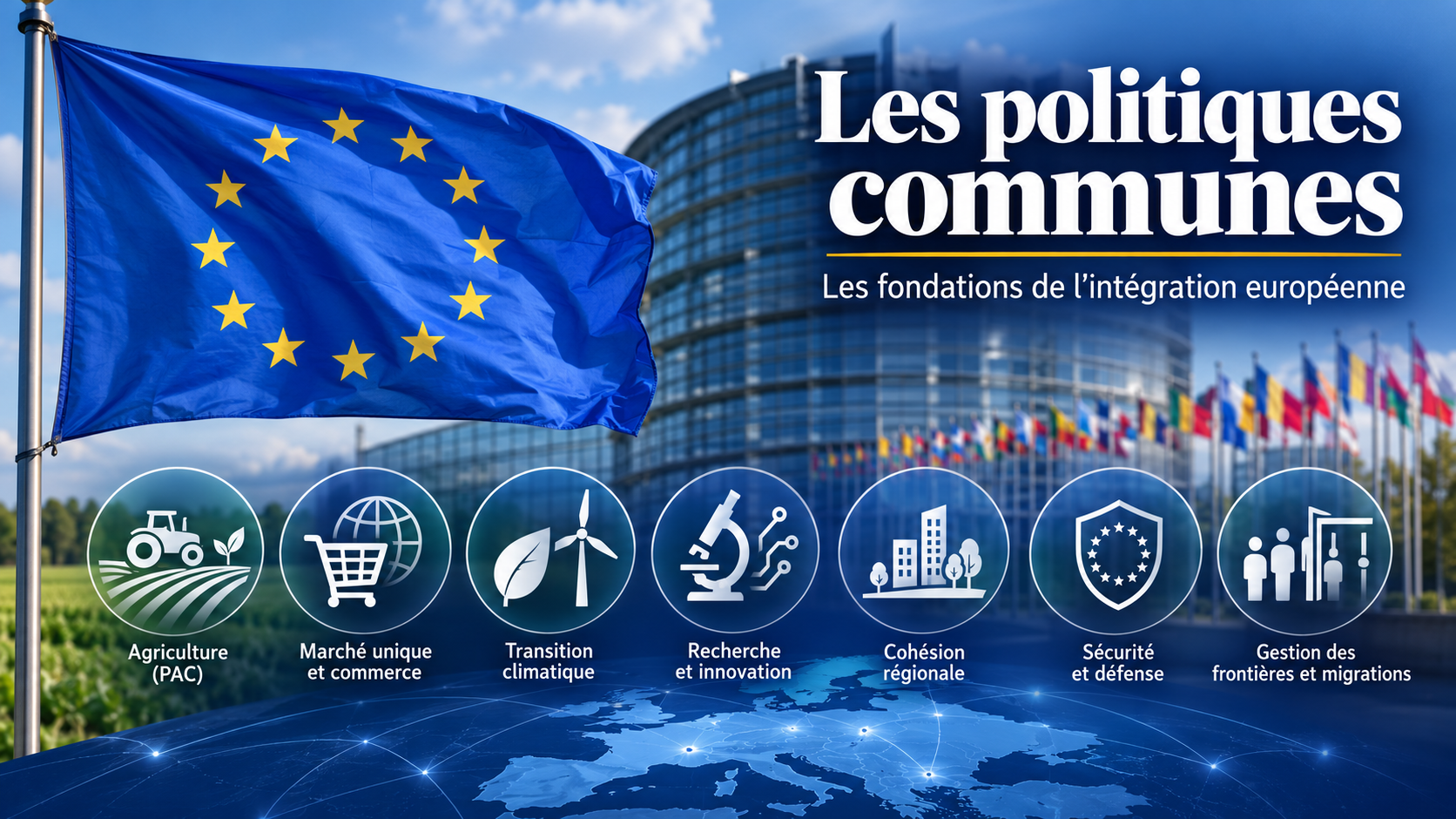
For decades, the European Union built much of its prosperity upon open markets, stable international rules, and expanding economic interdependence.
European integration was largely founded on the belief that trade promotes peace and that globalization would reinforce long-term stability. Recent crises have compelled European policymakers to reconsider some of these assumptions.
- Energy dependence.
- Semiconductor shortages.
- Technological competition.
- Foreign investment in critical infrastructure.
- Disruptions to global supply chains.
Each has demonstrated that economic openness must increasingly be balanced with strategic resilience.
The European Union is therefore seeking a delicate equilibrium. It aims to preserve the benefits of globalization while reducing excessive dependencies in critical sectors.
Industrial policy, technological investment, supply diversification, and the strengthening of domestic production capacities have all become central elements of Europe's evolving strategy. Europe is not turning away from globalization. It is attempting to manage its risks more effectively.
The United States: An External but Indispensable Power
Geographically, the United States belongs to the American continent. Strategically, however, it has remained deeply engaged in Eurasia since the end of the Second World War.
American military alliances extend across Europe, the Middle East, and the Indo-Pacific. These commitments serve multiple objectives: protecting freedom of navigation, supporting allies, securing global trade routes, and preventing the emergence of any power capable of dominating Eurasia as a whole. Strategic competition with China has reinforced this logic.
Washington's partnerships with Japan, South Korea, Australia, NATO members, and several Asian partners are designed not to conquer Eurasia but to preserve a favorable balance of power across the continent. For the United States, Eurasia remains less a territory to control than a geopolitical space where no single actor should achieve uncontested dominance.
India: The Emerging Pivot Power
India has long been viewed primarily as a regional power. Today, it is increasingly becoming a continental one. Its demographic weight, expanding economy, technological capabilities, and strategic location place it at the center of Eurasia's evolving balance of power.
Positioned between the Indian Ocean, the Middle East, and East Asia, India enjoys exceptional diplomatic flexibility. It maintains relationships with a remarkably diverse range of partners while preserving substantial strategic autonomy.
Rather than aligning permanently with a single geopolitical bloc, New Delhi generally favors issue-based partnerships shaped by national interests. This flexibility provides India with significant room for maneuver in an increasingly fragmented international environment. As its economic influence continues to grow, India is emerging as one of the principal balancing powers of twenty-first-century Eurasia.
The Strategic Middle Powers
Eurasia's geopolitical architecture cannot be understood solely through its largest powers. Several medium-sized states possess strategic influence that exceeds their demographic or economic weight because of their geographical positions.
Türkiye controls the Bosporus and the Dardanelles, the maritime gateway between the Black Sea and the Mediterranean, while serving as a bridge between Europe, the Caucasus, and the Middle East.
Iran occupies a central position linking the Persian Gulf, Central Asia, the Caucasus, and the Indian Ocean. Despite decades of sanctions, its geography continues to provide enduring strategic significance.
The South Caucasus functions as an important corridor connecting the Caspian Basin with European markets.
Central Asia possesses abundant energy and mineral resources while linking China, Russia, the Middle East, and Europe.
The Gulf states are investing heavily in logistics, ports, digital infrastructure, financial services, and advanced technologies in order to transform geographical location into long-term economic influence.
These so-called middle powers illustrate a defining characteristic of today's international system. In a world organized around flows, controlling an interface can be just as valuable as controlling a vast territory.
A Competition Across Every Dimension
Strategic competition in Eurasia no longer resembles the imperial rivalries of previous centuries. It unfolds simultaneously across multiple domains.
- Infrastructure.
- Technology.
- Supply chains.
- Critical minerals.
- Energy.
- Financial systems.
- Industrial standards.
- Artificial intelligence.
- Space systems.
- Digital networks.
- Cybersecurity.
Each dimension reinforces the others. Building a railway corridor may strengthen diplomatic influence. Developing battery production may reshape industrial competitiveness. Controlling a critical technology can produce strategic effects comparable to military superiority.
Power has become systemic. Economic, technological, diplomatic, industrial, and military capabilities increasingly reinforce one another.
A Chessboard Without a Center
Unlike the great empires of history, contemporary Eurasia possesses no uncontested center of power. China dominates through manufacturing capacity and economic scale. The United States retains unmatched global military reach and considerable financial influence. The European Union remains a major economic and regulatory power. Russia continues to exercise significant military and energy influence. India's rise is reshaping continental balances. Türkiye, Iran, Japan, the Gulf states, and several regional actors each possess strategic advantages of their own.
This diversity fundamentally distinguishes Eurasia from any previous geopolitical order. No single power is capable of imposing its will across the entire continent. Every actor combines significant strengths with important vulnerabilities. Alliances evolve according to circumstances, interests converge in some areas while diverging in others, and economic cooperation increasingly coexists with strategic rivalry.
It is precisely this absence of a single center that makes Eurasia the defining laboratory of the contemporary international order. The continent's balance does not emerge from overwhelming dominance or permanent stability. Instead, it is shaped by a continuous process of adaptation among interdependent powers, where every strategic decision reverberates across the broader system.
To understand Eurasia is therefore to understand the future of world politics itself. The defining question of the twenty-first century is unlikely to be whether one power achieves global supremacy. It is far more likely to concern how the balance among multiple major powers evolves across the world's largest and most strategically interconnected continent.
The New Routes of Power
For centuries, power was largely measured by the amount of territory a state controlled. Empires expanded through conquest, colonization, and annexation. Borders represented the primary markers of political and military influence. To dominate a territory meant exercising direct authority over it.
The twenty-first century has not rendered this logic obsolete. Territory remains fundamental, as ongoing conflicts across Eurasia continue to demonstrate. Yet another dimension of power has progressively emerged alongside it: the ability to organize flows.
States no longer seek only to control land. They increasingly seek to control the movement of goods, energy, capital, data, technologies, and people that passes through that land. These flows have become the circulatory system of the global economy. The power to secure them, redirect them, facilitate them, or interrupt them increasingly defines geopolitical influence. More than any other region, Eurasia has become the principal laboratory of this transformation.
From Territorial Geography to Network Geography
Globalization has profoundly altered the nature of power. In an interconnected world, influence no longer depends solely on producing more wealth or possessing more natural resources. It increasingly depends upon guaranteeing that strategic flows remain continuous, efficient, resilient, and secure.
This evolution marks a transition from the geography of territories to the geography of networks. Borders still matter. But they no longer explain power on their own. Connections do. Interfaces do. Infrastructure does.
A railway linking multiple continents may generate greater long-term economic influence than a fortified frontier. A submarine cable may become more strategically valuable than a military installation. A logistics hub may reshape regional trade more profoundly than a diplomatic agreement. Contemporary power is increasingly exercised through connectivity rather than simple possession.
Economic Corridors: The New Arteries of the Continent
Across Eurasia, a growing number of economic corridors are redefining the geography of trade. These are not merely transportation projects. They integrate railways, highways, ports, logistics platforms, industrial parks, energy infrastructure, and digital networks into comprehensive systems designed to accelerate commerce and strengthen regional integration China's Belt and Road Initiative remains the most visible example. Far more than an infrastructure program, it represents an effort to reshape Eurasian connectivity by linking China more closely to Central Asia, Europe, the Middle East, Africa, and Southeast Asia through an extensive network of transportation and investment corridors.
Other initiatives reflect similar ambitions. The India–Middle East–Europe Economic Corridor (IMEC), announced in 2023, seeks to establish an alternative trade route connecting India with Europe through the Gulf and the Eastern Mediterranean.
The International North–South Transport Corridor links Russia, the Caspian region, Iran, and the Indian Ocean, offering another strategic alternative for Eurasian commerce.
These initiatives should not necessarily be understood as mutually exclusive. Rather, they represent competing visions for organizing the continent's future flows. The strategic question is no longer simply who controls territory. It is increasingly who organizes connectivity.
Ports: The New Gateways of Eurasia
Although overland corridors are gaining importance, maritime transport remains indispensable. More than four-fifths of global merchandise trade by volume continues to travel by sea. Consequently, Eurasia's maritime frontiers host many of the world's largest and most sophisticated ports, including Shanghai, Ningbo-Zhoushan, Singapore, Busan, Rotterdam, and Dubai.
Modern ports are no longer limited to loading and unloading cargo. They function as integrated economic ecosystems where shipping, logistics, manufacturing, finance, customs services, digital infrastructure, and industrial clusters converge.
Competition among ports extends far beyond commercial considerations. Becoming a major logistical hub attracts investment, stimulates industrial development, creates employment, and strengthens geopolitical influence. Control over maritime gateways has therefore become a major source of economic power.
Energy: From Pipelines to Integrated Networks
Energy infrastructure illustrates the transformation of geopolitical power particularly well. For much of the twentieth century, energy geopolitics focused primarily on oil and natural gas reserves. Today, the networks that transport, distribute, and increasingly store energy have become equally significant.
- Pipelines and gas transmission systems create long-term interdependence between producers and consumers.
- Electricity interconnections increasingly link neighboring economies.
- Hydrogen infrastructure may reshape future energy systems.
- Smart grids and large-scale storage technologies are becoming strategic assets.
The transition toward lower-carbon energy systems is not eliminating geopolitics. It is redefining it. Energy power increasingly depends not only upon owning resources but upon organizing the infrastructure through which energy circulates.
Critical Minerals: The Geography of Tomorrow's Industries
Hydrocarbons are no longer the sole foundation of industrial power. The technologies shaping the twenty-first century rely upon a growing range of strategic materials : Lithium, Cobalt, Nickel, Graphite, Copper, Rare earth elements and Gallium.
These resources underpin electric vehicles, renewable energy systems, semiconductors, telecommunications equipment, aerospace technologies, and artificial intelligence. Extraction alone is insufficient. Refining often represents the most strategically valuable stage. Manufacturing transforms these refined materials into advanced industrial products.
This explains why governments increasingly seek to secure complete industrial ecosystems rather than isolated resource deposits. Industrial geography has become every bit as important as geological geography.
Submarine Cables: The Invisible Infrastructure of Globalization
The digital economy often appears intangible. Its physical foundations tell another story. Nearly all international internet traffic travels through submarine fiber-optic cables stretching across the ocean floor. These cables connect financial centers, cloud computing facilities, research institutions, multinational corporations, and billions of individual users.
Damage to even a small number of these systems could disrupt financial transactions, communication networks, cloud services, and international commerce. Protecting them has therefore become a matter of national security.
Their routes are never accidental. They reflect geopolitical relationships, commercial partnerships, technological ecosystems, and strategic priorities. The infrastructure of the digital economy is therefore deeply geographical.
Data Centers: The Factories of the Twenty-First Century
In the industrial age, steel mills symbolized economic power. Today, data centers increasingly fulfill a comparable role. These facilities host cloud computing platforms, financial services, artificial intelligence models, e-commerce systems, public administration, scientific research, and an ever-growing share of global economic activity.
Their location depends upon multiple strategic variables.
- Reliable electricity.
- Political stability.
- International connectivity.
- Climate conditions.
- Water availability.
- Legal certainty.
- Cybersecurity.
Constructing a data center therefore means much more than installing servers. It integrates a territory into the global digital economy. Governments increasingly view these facilities as strategic infrastructure essential to technological sovereignty.
Semiconductors: The Strategic Industry
Few sectors illustrate the return of geography more clearly than semiconductors. These tiny components power virtually every modern technology, from smartphones and automobiles to aircraft, satellites, industrial machinery, hospitals, telecommunications networks, and advanced weapons systems.
Design, fabrication, packaging, and equipment manufacturing are distributed across multiple countries, creating one of the world's most complex industrial ecosystems. The concentration of certain critical production stages within only a handful of locations has transformed semiconductors into one of the defining strategic industries of our time.
Industrial policies introduced by the United States, the European Union, Japan, South Korea, and China all pursue a similar objective. To secure reliable domestic or allied production capacity for technologies considered indispensable to both economic competitiveness and national security.
Artificial Intelligence: A New Geopolitical Layer
Artificial intelligence is often portrayed primarily as a software revolution. In reality, it depends upon an extraordinary physical infrastructure.
- Training advanced AI models requires enormous computing power.
- Massive data centers.
- Specialized processors.
- Stable electricity supplies.
- Cooling systems.
- High-capacity communication networks.
- AI therefore adds a new layer to geopolitical competition.
- The challenge extends well beyond algorithms.
It encompasses semiconductor production, access to critical minerals, energy generation, cloud infrastructure, scientific talent, and advanced manufacturing capabilities.
The countries capable of integrating these elements into coherent industrial ecosystems will enjoy significant strategic advantages. Once again, Eurasia occupies a central position within this emerging landscape.
Standards: The Quiet Power
Not every form of geopolitical influence is visible. Technical standards. Industrial regulations. Digital governance. Environmental certification. Technology protocols. Financial reporting rules. All shape international commerce. Whoever establishes standards often influences markets for decades.
- Companies adapt products.
- Investors redirect capital.
- Governments revise regulations.
- Supply chains reorganize accordingly.
The ability to define rules has therefore become a subtle but highly durable form of power. The European Union, the United States, China, and several international organizations actively compete in this normative arena.
Building the Architecture of Global Flows
Understanding Eurasia today requires looking beyond political borders. One must instead observe the railway corridors crossing the Eurasian steppe.
- The pipelines connecting energy basins to industrial centers.
- The submarine cables carrying digital communications.
- The electrical grids supporting the energy transition.
- The shipping lanes linking the world's major ports.
- The data centers powering the digital economy.
- The semiconductor factories producing the technologies of tomorrow.
Together, these infrastructures form the invisible architecture upon which contemporary globalization depends. Competition among major powers is therefore becoming less about conquering territory than about shaping this architecture.
- Building connections.
- Securing flows.
- Creating resilient networks.
- Establishing technological standards.
- Strengthening industrial ecosystems.
- Ensuring reliable access to critical resources.
These objectives increasingly define strategic influence.
Eurasia has consequently become the principal crossroads of this new geography of power. The states investing across the continent are not simply constructing roads, ports, railways, pipelines, or digital infrastructure. They are shaping the networks through which the global economy will function for decades to come. In this emerging international order, influence no longer rests solely upon controlling territory. It increasingly belongs to those capable of connecting regions, organizing exchanges, securing critical flows, and building the infrastructure that sustains the world economy. In that sense, Eurasia has become not merely the largest continent on Earth, but the central platform upon which the architecture of twenty-first-century power is being built.
Eurasia and the Twenty-First Century
The previous chapters lead to a conclusion that extends far beyond geography itself. Eurasia has not returned to prominence simply because it contains vast populations, abundant natural resources, or strategic infrastructure. It has become central once again because it is the principal arena in which the balance of the international system is being reshaped.
This conclusion requires an important clarification. To say that Eurasia lies at the center of world affairs does not imply that it will one day become a politically unified entity. Nothing in its history, geography, or extraordinary diversity supports such an assumption. The continent encompasses democracies and authoritarian regimes, advanced industrial economies and developing states, multiple civilizations, languages, religions, and strategic cultures. These differences make the emergence of a single Eurasian political union highly improbable.
The essential question is therefore not one of unity. It is one of centrality. For the center of the world is not necessarily the actor that governs everyone else. More often, it is the space whose evolution compels every other actor to adapt.
The Return of Geography as the Organizing Principle
Throughout much of the second half of the twentieth century, the global economy was understood primarily as a system driven by expanding trade. International institutions, economic liberalization, and increasingly integrated markets appeared to point toward a gradual convergence among the world's major regions.
The twenty-first century has not reversed this trend entirely.
International trade continues to expand.
Investment continues to cross borders.
Global supply chains remain deeply interconnected.
Yet the logic organizing these exchanges has fundamentally changed.
The priority is no longer simply to produce at the lowest possible cost:
- It is to guarantee resilient supply chains.
- To secure critical infrastructure.
- To diversify strategic partnerships.
- To reduce excessive dependencies.
This transformation places geography back at the heart of political decision-making.
- Trade routes.
- Maritime chokepoints.
- Rail corridors.
- Power grids.
- Data centers.
- Digital infrastructure.
- Critical minerals.
Each has become an essential component of national security. The world is not returning to the nineteenth century. It is entering a new era in which economics and geography have become inseparable once again.
A More Political Globalization
The globalization emerging in the twenty-first century differs fundamentally from that which characterized previous decades.
- Companies no longer make decisions solely according to efficiency.
- Governments intervene more actively in industrial policy.
- Strategic sectors receive public support.
- Sensitive technologies are increasingly subject to export controls.
- Foreign investment faces greater scrutiny.
- Critical infrastructure has become an issue of sovereignty.
This evolution does not signal the end of globalization. It signals its transformation. International exchanges continue. But they are increasingly shaped by geopolitical considerations. Economics is becoming an extension of strategy.
The Possible Futures
The future of Eurasia remains open. Several trajectories are possible.
The first scenario is one of increasing fragmentation. Growing geopolitical rivalry could produce additional trade barriers, more regionalized supply chains, and sharper competition among economic blocs. Such a development might reduce certain strategic vulnerabilities while increasing production costs and geopolitical instability.
A second scenario envisions a Eurasia organized around several major centers of power. China, the European Union, India, Russia, Türkiye, the Gulf states, and other regional actors would continue defending their own interests while expanding pragmatic cooperation wherever objectives converge. This multipolar configuration appears particularly compatible with the continent's diversity.
A third, more ambitious but less certain scenario would involve gradual functional integration. Without creating political unity, Eurasian states could deepen cooperation in transportation, energy, digital infrastructure, financial systems, and industrial development whenever mutual interests align.
Finally, a fourth scenario would see strategic competition between the United States and China becoming the principal organizing force across the continent.
Other powers would then seek to preserve their strategic autonomy by avoiding complete alignment with either side. None of these scenarios excludes the others. Eurasia may simultaneously experience deeper cooperation in certain sectors while becoming increasingly fragmented in others.
Europe and the Return of the Continent
For Europe, Eurasia's resurgence represents a profound strategic transformation. For centuries, Western Europe occupied the center of an international order largely organized around the Atlantic. Europe remains one of the world's foremost economic and technological powers. It is no longer, however, the uncontested center of global growth.
Its future prosperity increasingly depends upon its ability to integrate into Eurasia's evolving dynamics while preserving its own strategic autonomy. Achieving this balance requires continued investment in infrastructure, industrial competitiveness, technological innovation, energy security, and diversified partnerships across the continent.
Europe's challenge is therefore not to choose between the Atlantic and Eurasia. It is to remain an influential actor in both.
Africa: The Strategic Neighbor
Eurasia's transformation also reshapes Africa's strategic position. Long viewed as peripheral to the principal centers of global economic activity, Africa is acquiring increasing importance because of its geographical proximity to Europe, the Middle East, and the Indian Ocean.
Investment in ports, transport corridors, critical minerals, energy infrastructure, and industrial capacity reflects this evolution. Africa's future will naturally depend upon its own political and economic choices. Yet Eurasia's transformation will profoundly influence the continent's commercial opportunities, industrial development, technological partnerships, and long-term integration into global value chains. Africa could therefore emerge as one of the principal partners of the new geography taking shape across Eurasia.
The Middle East: From Transit Zone to Strategic Connector
The Middle East occupies a distinctive position within the emerging Eurasian order. For decades, international attention focused primarily on its hydrocarbons or its conflicts. Today, the region is increasingly recognized as one of the principal interfaces connecting Europe, Asia, and Africa. Massive investment in ports, logistics platforms, digital infrastructure, financial services, renewable energy, and hydrogen production illustrates this transformation.
Many states are actively seeking to convert geographical location into sustainable economic influence. Their strategic significance increasingly extends beyond energy exports alone.
Businesses in a New Geography
The return of geography directly affects corporate strategy.
- Choosing an industrial location.
- Selecting suppliers.
- Designing resilient supply chains.
- Determining where to build data centers.
- Securing access to critical resources.
- Evaluating geopolitical risk.
Each of these decisions now requires a far deeper understanding of international politics than was often necessary only a generation ago. The distinction between corporate strategy and geopolitical strategy is steadily narrowing. The geography has once again become a competitive advantage.
Investors in an Age of Strategic Uncertainty
Investors face a similarly transformed environment. Traditional financial analysis remains indispensable. But it is no longer sufficient. Investment decisions increasingly require consideration of geopolitical risk, industrial policy, technological competition, trade restrictions, infrastructure security, and supply chain resilience.
Financial markets no longer respond only to corporate earnings. They react to sanctions. Infrastructure disruptions. Export controls. Political decisions. Technological competition. Geopolitics has become an economic variable in its own right.
Citizens in an Interdependent World
The return of Eurasia affects not only governments and multinational corporations. It also influences everyday life.
- Energy prices.
- Transportation costs.
- The availability of consumer goods.
- Digital technologies.
- Industrial employment.
- Public investment.
- Energy transitions.
- Digital infrastructure.
Each depends, to varying degrees, upon strategic decisions made across the Eurasian continent. Globalization has brought economies closer together. The return of geography reminds us that this interdependence remains deeply rooted in physical space.
Conclusion: The Continent That Will Shape the Century
For nearly five centuries, world history was largely organized around the oceans. The Age of Discovery, colonial empires, maritime trade routes, and naval supremacy shaped the first truly global economic system. The Atlantic became the principal artery through which goods, capital, ideas, and influence circulated.
The twenty-first century does not erase that legacy. The oceans will continue carrying the overwhelming majority of world trade. Maritime powers will remain indispensable to international stability. Yet a quieter transformation is unfolding.
The defining issues of our era—energy security, critical minerals, industrial supply chains, artificial intelligence, digital infrastructure, technological competition, and strategic connectivity—all increasingly converge upon a single geographical space. Eurasia.
The fundamental shift is therefore not the replacement of one continent by another. It is the return of a historical reality. For most of human history, the world's great civilizations, major empires, technological breakthroughs, and commercial networks developed across this immense continental space.
The centuries of predominantly Atlantic dominance increasingly appear not as a permanent condition of history, but as a remarkable historical chapter. Eurasia is therefore recovering its original function.
It is once again becoming the principal space where populations, resources, technologies, infrastructure, capital, and geopolitical ambitions converge. It is not an empire. It is not a political bloc. It does not speak with a single voice.
And that is precisely what makes it so strategically important. Because no single power can unify Eurasia, every major power seeks to secure its place within it. Because no state can dominate the continent entirely, all are compelled to negotiate, invest, compete, cooperate, and adapt.
The twenty-first century is therefore unlikely to belong to one dominant power. It is far more likely to be defined by the evolving balance among several major centers of influence. At the heart of that transformation stands Eurasia. Not as the capital of the world. But as its principal arena of interaction.
To understand Eurasia is therefore not merely to study another region. It is to understand the geographical framework within which the defining economic, technological, political, and strategic decisions of the coming decades will be made.
More than a continent, Eurasia has once again become the stage upon which the architecture of the contemporary international order is being constructed. Whoever seeks to understand the twenty-first century must therefore begin by understanding Eurasia.
Atlas Observer Research Desk
Atlas Observer’s editorial and analytical desk.