The Return of a Total Strategic Asset
Nuclear power is experiencing a marked resurgence in contemporary state strategies. Long marginalized in certain advanced economies, particularly in Western Europe, it is now re-emerging as a central component of energy and industrial policy.
This return is not merely a technical adjustment. It reflects a deeper transformation of the international system, characterized by the reactivation of great power competition, the fragmentation of supply chains, and the reassessment of excessive interdependencies.
In this context, nuclear power can no longer be understood as a sectoral technology. It constitutes an integrated strategic infrastructure at the intersection of energy, industry, sovereignty, and geopolitics.
I. A Structuring Energy Source in an Unstable Energy System
The primary driver behind the return of nuclear power lies in the nature of the global energy system itself.
Rising geopolitical tensions—illustrated notably by the war in Ukraine and disruptions to hydrocarbon flows—have exposed the vulnerability of economies dependent on imported resources and critical logistical routes. In this environment, nuclear energy offers a key advantage: it largely decouples electricity generation from continuous supply flows.
Unlike gas or oil, whose availability depends on permanent logistical chains, nuclear power relies on fuel that can be stockpiled and planned over the long term. This characteristic reduces exposure to external shocks and provides a form of structural stability to energy systems.
Moreover, within the context of the low-carbon transition, nuclear energy is one of the few sources capable of delivering large-scale, dispatchable electricity without direct CO₂ emissions. It does not replace renewable energy, but rather compensates for its structural limitations, particularly intermittency.
Nuclear power thus emerges as a stabilizing component within increasingly constrained and complex energy systems.
II. A Political Economy Favoring Strategic States
Beyond its physical properties, nuclear power is defined by a distinct political economy.
The sector is characterized by extremely high upfront capital expenditures, long construction timelines, and amortization cycles spanning several decades. This structure inherently limits the role of purely private actors and places the state at the center—as financier, regulator, and often operator.
As a result, nuclear power tends to reinforce models in which the state plays a structuring role in the economy. It is poorly suited to fragmented, short-term market logics, given the need for long-term planning, continuity, and risk management.
This distinguishes nuclear energy from other segments of the energy sector and makes it a preferred instrument for states seeking to consolidate strategic autonomy.
III. A Highly Strategic and Concentrated Value Chain
Nuclear power extends far beyond electricity generation. It relies on a complete value chain, each segment of which carries distinct geopolitical implications.
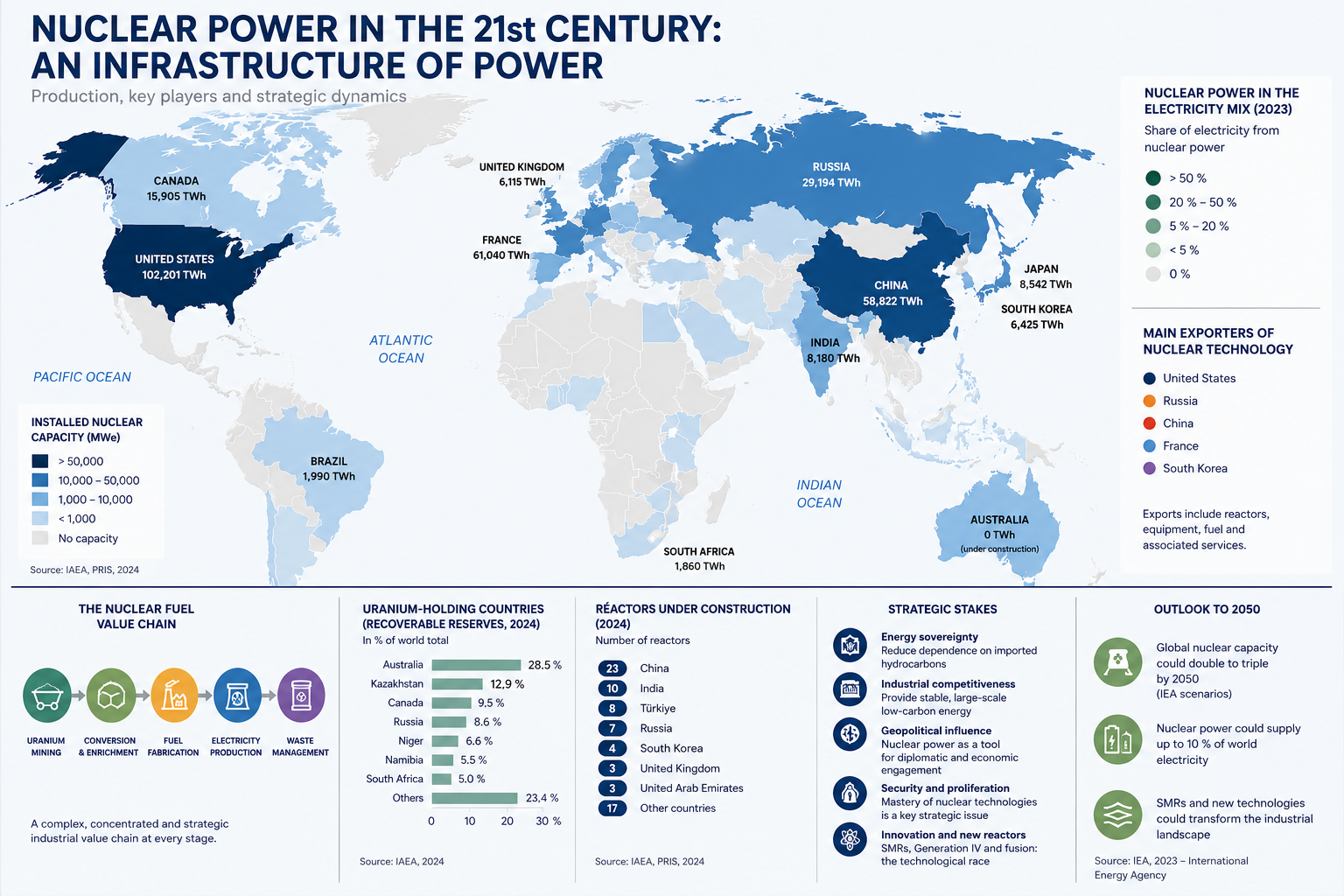
Upstream, uranium extraction is concentrated in a limited number of countries, including Kazakhstan, Canada, Australia, and several African states such as Niger. This geographical concentration introduces challenges related to supply security and influence over producing regions.
However, the enrichment segment represents the true core of nuclear power. Capabilities are concentrated among a small group of actors, notably Russia, the United States, Europe (through consortia such as Urenco), and increasingly China. Mastery of this stage determines effective access to nuclear fuel—and therefore to nuclear energy itself.
Downstream, the construction and maintenance of nuclear power plants entail long-term commitments. A single reactor implies decades of cooperation with the original supplier, creating enduring technological and industrial dependence.
In this sense, nuclear power generates structured, deep, and difficult-to-reconfigure dependencies.
IV. An Instrument of Influence and Power Projection
This industrial structure gives nuclear power a direct geopolitical dimension.
The export of nuclear technologies is typically accompanied by integrated financial, technical, and regulatory frameworks. Supplier states do not merely deliver infrastructure; they establish long-term relationships that can extend over half a century.
Russia, through Rosatom, has developed this model extensively by offering comprehensive packages that include financing, construction, operation, and training. China is progressively adopting a similar approach, particularly within its broader infrastructure initiatives.
These strategies make nuclear power a tool of durable influence, enabling states to anchor asymmetric bilateral relationships and project power beyond their borders.
V. A Structurally Porous Boundary Between Civil and Military Uses
One of the defining features of nuclear power is the inherent permeability between its civilian and military applications.
The development of a civilian nuclear program requires the acquisition of technologies, infrastructure, and expertise that can, under certain conditions, be redirected toward military purposes. Uranium enrichment, in particular, represents a critical threshold.
This dual-use nature places nuclear power at the center of proliferation and international security concerns. It also explains the heightened scrutiny by major powers and international institutions regarding emerging nuclear programs.
At the same time, nuclear deterrence remains a cornerstone of strategic stability among major powers. It is based on a paradoxical logic in which the possession of nuclear weapons is intended to prevent their use by establishing a balance of terror.
Nuclear power thus simultaneously embodies a factor of stability and a source of systemic risk.
VI. Nuclear Power in the Global Energy Transition
One of the central paradoxes of the current period is the rehabilitation of nuclear power within climate strategies.
While previous decades were marked by a relative decline in some regions, the constraints associated with decarbonization and energy security are leading many states to reassess their positions.
This shift is particularly visible in Asia, where China and India are expanding their nuclear capacities significantly, as well as in Japan, which is gradually restarting its nuclear fleet. In Europe, positions remain more fragmented, but several countries are reinvesting in nuclear energy.
Nuclear power is increasingly viewed as a necessary complement to renewable energy, providing stability to electricity systems that are becoming more dependent on intermittent sources.
VII. Persistent Structural Constraints
Despite its advantages, nuclear power faces significant constraints.
Construction costs and timelines remain major challenges, particularly in economies where industrial capabilities have been partially eroded. Cost overruns observed in recent projects highlight the complexity of the sector.
Social acceptability also remains a key factor, especially in democratic systems where risk perception can heavily influence policy decisions.
Finally, waste management raises long-term technical and ethical questions, particularly regarding intergenerational responsibility.
These constraints do not negate the relevance of nuclear power, but they shape its deployment and complicate its governance.
VIII. Innovation Dynamics and Prospects for Transformation
The future of nuclear power will depend, in part, on ongoing technological innovation.
Small Modular Reactors (SMRs) aim to reduce costs and construction times while offering greater flexibility. Next-generation reactors seek to improve fuel efficiency and reduce waste production.
In the longer term, nuclear fusion represents a potential breakthrough, although its timeline remains uncertain.
These technological developments are embedded in an intensifying global competition, where innovation capacity becomes an additional determinant of power.
An Architecture of Power in a Fragmented World
Nuclear power cannot be reduced to a simple energy option.
It constitutes a complex architecture that shapes energy systems, industrial capabilities, dependency structures, and geopolitical balances.
In an international environment marked by uncertainty and fragmentation, it provides states that master it with a lever for stabilization and autonomy. It does not eliminate dependency, but transforms it—making it more predictable and, in some cases, more controllable.
The resurgence of nuclear power reflects a broader shift: the return of energy as a central strategic issue, and the growing importance of infrastructure control in determining state power.
Summary — 10 Key Figures
- The energy transition is not just about climate. It is about control.
- Nuclear is the only scalable energy source that combines stability, density, and low emissions.
- Renewables produce energy. Nuclear stabilizes systems.
- Energy independence is a mythe. The real question is: who controls your dependencies?
- Nuclear power does not remove dependence. It locks it into long-term, structured systems.
- The real power is not reactors. It is enrichment.
- A nuclear plant is not just infrastructure. It is a 50-year geopolitical relationship.
- Civil nuclear programs are never purely civilian. They always carry strategic implications.
- Russia and China understood this early. They export influence — not just energy.
- The real shift is this: Energy is no longer a market issue. It is a sovereignty issue.
Atlas Observer Research Desk
Atlas Observer’s editorial and analytical desk.