Introduction
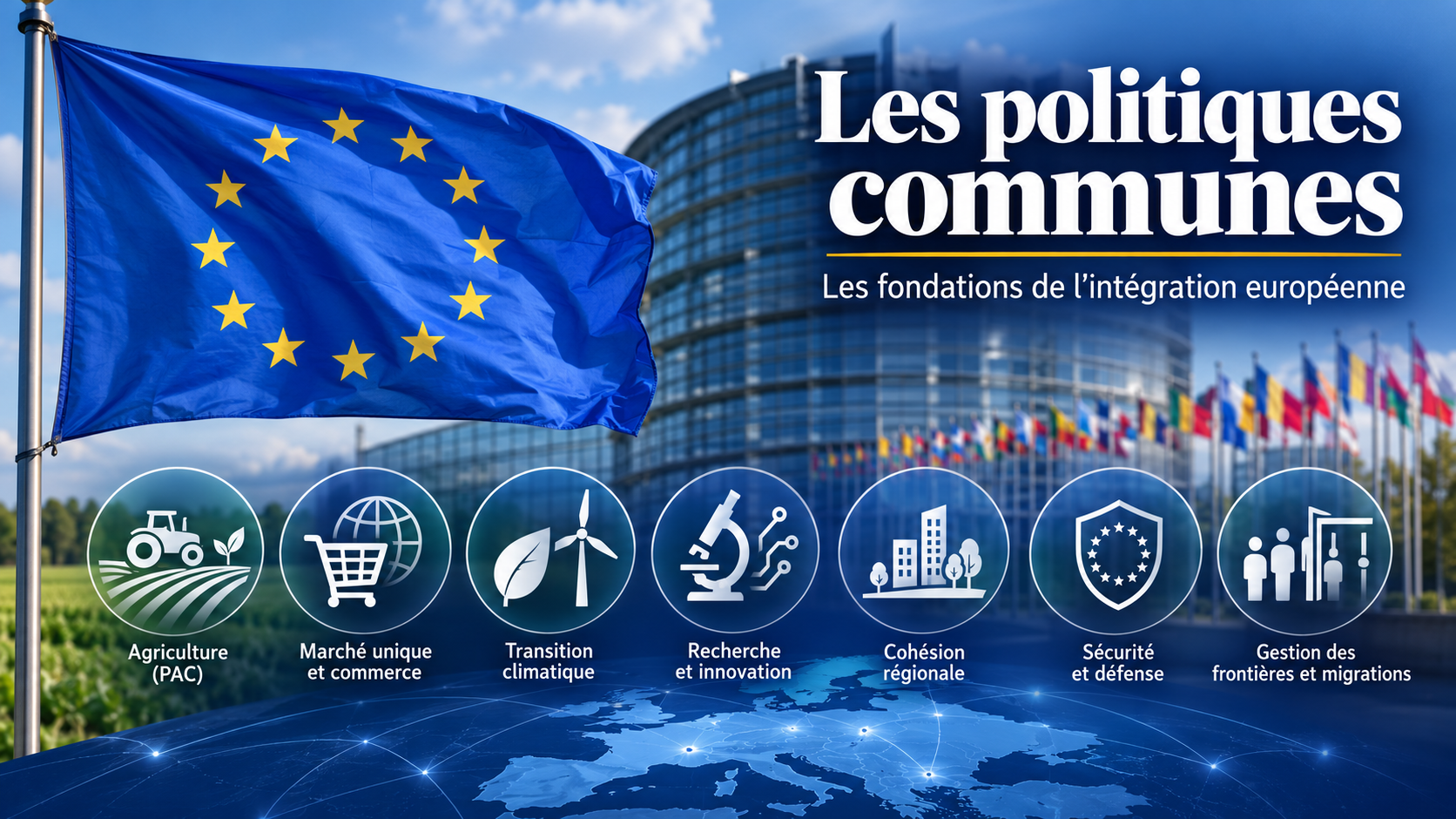
The European Union is often presented through its institutions, summits and political debates. Yet its influence is measured above all through the common policies it implements. These policies form the operational core of European integration: they establish shared rules, finance projects, organize economic exchanges and coordinate the actions of Member States in areas considered strategic.
This approach distinguishes the European Union from most international organizations. Member States do not merely cooperate; they have chosen to share part of their competences in order to pursue common objectives. This limited transfer of sovereignty makes it possible to adopt standards applicable across the European market, pool certain forms of financing and carry greater weight in an international environment shaped by competition between major powers.
Over the decades, these policies have gradually expanded. Initially focused on coal, steel and trade, they now cover agriculture, monetary affairs, the environment, research, infrastructure, competition, external borders, digital regulation and, to a more limited extent, security and defence.
Their evolution also reflects broader global transformations. Financial crises, the Covid-19 pandemic, the war in Ukraine, the energy transition and accelerating technological change have led the Union to strengthen its role in several fields that were previously largely reserved for national governments.
The Single Market: The Cornerstone of the Union
Gradually established and formally launched in 1993, the single market is the most emblematic achievement of European integration. It is based on four fundamental freedoms: the free movement of people, goods, services and capital.
This framework allows European companies to access a market of nearly 450 million consumers without internal customs barriers. Citizens can work, study or settle in another Member State under certain conditions, while investors benefit from a largely harmonized regulatory environment.
Beyond the removal of economic borders, the single market has also encouraged the emergence of common standards that often influence practices internationally. European rules on data protection, food safety and competition illustrate this regulatory influence, sometimes described as the “Brussels effect.”
The single market nevertheless remains incomplete in certain sectors, particularly financial services, digital markets and capital markets, where national differences continue to limit integration.
The Common Agricultural Policy: A Historic Pillar
Created in 1962, the Common Agricultural Policy, or CAP, remains one of the oldest and most structurally important policies of the Union.
Its original objective was to guarantee Europe’s food security while ensuring stable incomes for farmers following the shortages of the post-war period.
Over successive reforms, the CAP has gradually shifted towards more sustainable agriculture. Financial support is now increasingly linked to environmental criteria, biodiversity protection and adaptation to climate change.
The CAP nevertheless remains subject to regular criticism. Some argue that subsidies mainly benefit large agricultural holdings, while others believe that environmental requirements are becoming increasingly difficult to reconcile with agricultural competitiveness.
A Common Trade Policy
Unlike other areas in which competences are shared, trade policy falls largely under the authority of the European Union. The European Commission negotiates trade agreements on behalf of the twenty-seven Member States. This unified competence gives the Union considerable influence in international negotiations.
The European Union is now one of the world’s leading trading powers. Its agreements cover partners across all continents and address not only customs duties, but also sanitary standards, investment rules and intellectual property.
This policy nevertheless remains the subject of recurring debate concerning the protection of strategic industries, international competition and the environmental requirements imposed on trading partners.
Competition Policy: Preserving an Open Market
Competition policy is intended to ensure that companies operate within a fair economic environment. The European Commission reviews major corporate mergers, fights cartels, sanctions abuses of dominant positions and regulates state aid that may distort competition.
This authority gives the Union a degree of global influence. Several European decisions involving major technology companies have had consequences far beyond the European market.
However, the emergence of powerful corporations supported by foreign governments has led some European policymakers to question whether competition policy should be adapted to facilitate the development of large European industrial champions.
Economic and Monetary Union
The introduction of the euro represents one of the major milestones of European integration. The single currency facilitates trade, reduces transaction costs and strengthens financial stability among participating countries.
The European Central Bank is responsible for monetary policy in the euro area, with price stability as its primary objective.
The financial crises of the 2010s, followed by the return of inflation after the pandemic, demonstrated that sharing a currency also requires closer economic coordination among Member States.
The absence of a genuine fiscal union remains one of the central debates concerning the future of the euro area.
Cohesion Policies
Cohesion policies are among the European Union’s principal investment instruments. Their objective is to reduce development gaps between European regions by financing infrastructure, vocational training, innovation, transport, the energy transition and local development.
These investments contribute to strengthening economic convergence within the single market. They also reflect a broader principle of territorial solidarity intended to support the Union’s less-developed regions.
Climate and Energy Policies
Faced with the climate emergency, the European Union has gradually emerged as one of the leading advocates of the energy transition. The European Green Deal sets the objective of achieving climate neutrality by 2050.
This strategy mobilizes substantial investment in renewable energy, electricity infrastructure, energy efficiency, the circular economy and low-carbon technologies.
The energy crisis triggered by the war in Ukraine also accelerated policies aimed at reducing Europe’s dependence on imported fossil fuels.
These transformations nevertheless represent a major challenge for certain industries facing international competitors subject to less demanding environmental constraints.
Schengen and Border Management
The Schengen area enables the free movement of people between most participating states without systematic checks at internal borders. This freedom is one of the most visible achievements of European integration.
At the same time, the Union has gradually strengthened the common management of its external borders through the development of Frontex, police cooperation and European information systems.
Migration crises have nevertheless exposed persistent disagreements over the distribution of responsibilities among Member States.
Research, Innovation and Technological Sovereignty
For several decades, the European Union has financed programmes designed to strengthen its scientific competitiveness. These investments support fundamental research, disruptive technologies, healthcare, space, artificial intelligence, semiconductors and digital infrastructure.
Such policies are intended to reduce technological dependence on major industrial powers while stimulating European innovation.
The scale of American and Chinese investment in strategic technologies has now placed technological sovereignty at the centre of the Union’s industrial priorities.
Security and Defence: Integration Remains Limited
Unlike economic policy, defence remains primarily a national competence. The European Union has nevertheless developed several instruments designed to strengthen cooperation among Member States, particularly in capability development, defence industry coordination and operational cooperation.
The war in Ukraine accelerated this process through increased joint investment, coordinated military support and a broader debate on European strategic autonomy.
However, NATO remains the principal framework for collective defence for the majority of EU Member States.
The Limits of Common Policies
The effectiveness of European policies depends constantly on the balance between integration and national sovereignty. Economic, demographic and political differences among Member States can make it difficult to reach the compromises required to adopt new measures.
Institutional rules that still require unanimity in certain sensitive areas can slow decision-making at a time when international crises evolve rapidly.
At the same time, citizens’ expectations of the European Union continue to grow even though its legal competences remain limited in several major policy areas.
Conclusion
Common policies are the true driving force of European integration. They give practical form to the willingness of Member States to act together when collective action is considered more effective than isolated national initiatives. From the single market to the common currency, from agricultural policy to regional investment, and from the climate transition to research, they structure an increasing share of the continent’s economic and regulatory activity.
The European Union is now entering a new phase of its development. Competition between major powers, the fragmentation of value chains, the artificial intelligence revolution, the demand for technological sovereignty, the energy and demographic transitions, and mounting security challenges are all testing the capacity of its common policies to evolve.
Their future will depend not only on their economic effectiveness, but also on their ability to preserve cohesion among Member States whose interests sometimes diverge. Much of Europe’s place in the twenty-first-century world will be determined by this balance between solidarity, competitiveness and shared sovereignty.
Main Sources
- European Commission — Single Market, European Green Deal, Common Agricultural Policy, Cohesion Policy, Research and Innovation.
- Council of the European Union — Operation of common policies and European decision-making processes.
- European Parliament — Fact Sheets on the European Union.
- Eurostat — Economic, social, regional and agricultural data.
- European Central Bank — Economic and Monetary Union and monetary policy.
- European Court of Auditors — Assessments of European policies and the use of EU funds.
- OECD — Studies on competitiveness, productivity and European public policy.
- International Monetary Fund — Macroeconomic analysis of the euro area.
- World Bank — Comparative data on economic development and infrastructure.
Atlas Observer Research Desk
Atlas Observer’s editorial and analytical desk.